Shrinking Sea: Over Half of the Aral Sea Has Vanished in Three Years
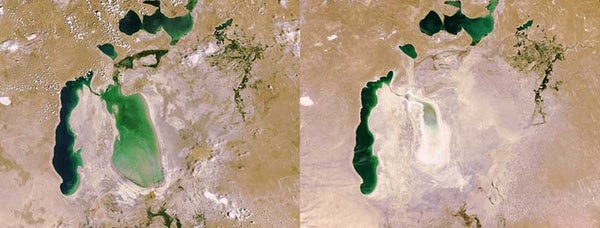
These two images, taken in 2006 [ left ] and 2009 by the European Space Agency's Envisat satellite , show the rapid loss of water in central Asia's Aral Sea , which is shared by Kazakhstan and Uzbekistan.
On supporting science journalism
If you're enjoying this article, consider supporting our award-winning journalism by subscribing. By purchasing a subscription you are helping to ensure the future of impactful stories about the discoveries and ideas shaping our world today.
These two images, taken in 2006 [left] and 2009 by the European Space Agency's Envisat satellite, show the rapid loss of water in central Asia's Aral Sea, which is shared by Kazakhstan and Uzbekistan.
Decades ago, the sea was the world's fourth largest body of inland water, but diversion of rivers for irrigation has been rapidly shrinking the sea. Two decades ago, it split into the small northern and larger southern sections, and further divisions have been happening ever since.
Kazakhstan and the World Bank partnered in 2005 to build a dike separating—and possibly saving—the northern parts of the sea, But at the current rate, the whole southern segment will likely be bone-dry by 2020.
Aside from lost shoreline, the sea's retreat has also created a new and dangerous feature in the landscape: the Aral Karakum Desert, a salty wasteland that is prone to sandstorms. High winds move about 150,000 metric tons of salt annually, which can harm people and change weather patterns (intensifying seasonal temperature differences).
It’s Time to Stand Up for Science
If you enjoyed this article, I’d like to ask for your support. Scientific American has served as an advocate for science and industry for 180 years, and right now may be the most critical moment in that two-century history.
SciAm always educates and delights me, and inspires a sense of awe for our vast, beautiful universe. I hope it does that for you, too.
If you subscribe to Scientific American, you help ensure that our coverage is centered on meaningful research and discovery; that we have the resources to report on the decisions that threaten labs across the U.S.; and that we support both budding and working scientists at a time when the value of science itself too often goes unrecognized.
In return, you get essential news, captivating podcasts, brilliant infographics, can't-miss newsletters, must-watch videos, challenging games, and the science world's best writing and reporting. You can even gift someone a subscription.
There has never been a more important time for us to stand up and show why science matters. I hope you’ll support us in that mission.