Side Step: Asymmetrical Skull Links Modern Flatfish to Ancient Relatives
Even though it had been in a museum in Vienna for years, Heteronectes had not been recognized for what it was—an intermediate form between "normal" fishes, with eyes on opposite sides of the head, and modern flatfish such as halibut and flounder, with both eyes on the same side.
On supporting science journalism
If you're enjoying this article, consider supporting our award-winning journalism by subscribing. By purchasing a subscription you are helping to ensure the future of impactful stories about the discoveries and ideas shaping our world today.
Even though it had been in a museum in Vienna for years, Heteronectes had not been recognized for what it was—an intermediate form between "normal" fishes, with eyes on opposite sides of the head, and modern flatfish such as halibut and flounder, with both eyes on the same side.
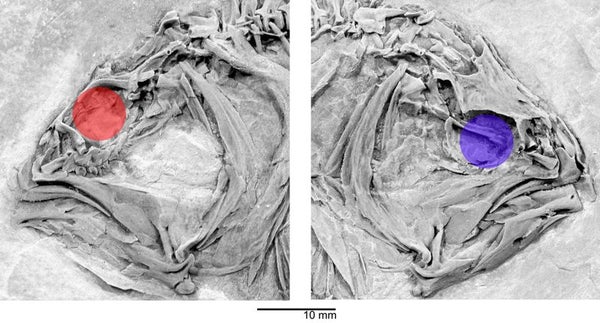
The left and right views of the skull illustrate the asymmetrical placement of Heteronectes's eyes. Colored dots indicate their locations: The right eye is in a normal place for a fish but the left eye socket is very high, almost on top of the head.
Matthew Friedman, a paleobiologist at the University of Oxford, found the 50-million-year-old fish fossil in museum archives on a research visit and extracted it from the surrounding rock. He has been studying flatfish evolution since graduate school.
Friedman says that one of the interesting things about this discovery is that it was hiding at the museum for so long. "Museums are wonderful places where discoveries continue to happen. They're not just archives where things that we've figured out are deposited to molder away," he says.
—Evelyn Lamb
It’s Time to Stand Up for Science
If you enjoyed this article, I’d like to ask for your support. Scientific American has served as an advocate for science and industry for 180 years, and right now may be the most critical moment in that two-century history.
SciAm always educates and delights me, and inspires a sense of awe for our vast, beautiful universe. I hope it does that for you, too.
If you subscribe to Scientific American, you help ensure that our coverage is centered on meaningful research and discovery; that we have the resources to report on the decisions that threaten labs across the U.S.; and that we support both budding and working scientists at a time when the value of science itself too often goes unrecognized.
In return, you get essential news, captivating podcasts, brilliant infographics, can't-miss newsletters, must-watch videos, challenging games, and the science world's best writing and reporting. You can even gift someone a subscription.
There has never been a more important time for us to stand up and show why science matters. I hope you’ll support us in that mission.