
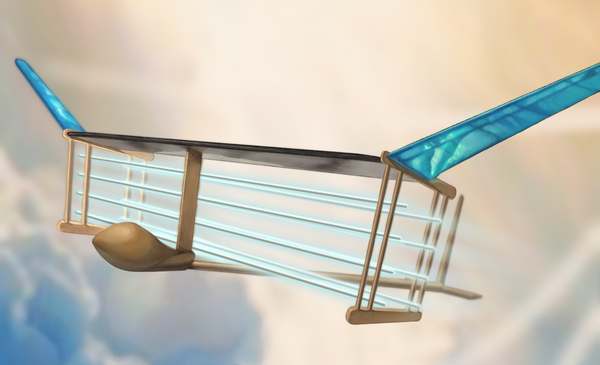
Behind a thin white veil separating his makeshift lab from joggers at a Massachusetts Institute of Technology indoor track, aerospace engineer Steven Barrett recently test-flew the first-ever airplane powered with ionic wind thrusters—electric engines that generate momentum by creating and firing off charged particles.
Using this principle to fly an aircraft has long been, according even to Barrett, a “far-fetched idea” and the stuff of science fiction. But he still wanted to try. “In Star Trek you have shuttlecraft gliding silently past,” he says. “I thought, ‘We should have aircraft like that.’”
Thinking ionic wind propulsion could fit the bill, he spent eight years studying the technology and then decided to try building a prototype miniature aircraft—albeit one he thought was a little ugly. “It’s a kind of dirty yellow color,” he says, adding that black paint often contains carbon—which conducts electricity and caused a previous iteration to fry itself.
On supporting science journalism
If you're enjoying this article, consider supporting our award-winning journalism by subscribing. By purchasing a subscription you are helping to ensure the future of impactful stories about the discoveries and ideas shaping our world today.
Barrett had slightly higher hopes for the latest prototype, which he dispassionately named Version 2. “Before we started the test flights I thought it had maybe a 50–50 chance,” he says. “My colleague at MIT thought it was more like a 1 percent chance it would work.”
Credit: MIT
But unlike its predecessors, which had tumbled to the ground, Version 2 sailed nearly 200 feet through the air at roughly 11 miles per hour (17 kilometers per hour). With no visible exhaust and no roaring jet or whirling propeller—no moving parts at all, in fact—the aircraft seemed silently animated by an ethereal source. “It was very exciting,” Barrett says. “Then it crashed into the wall, which wasn’t ideal.”
Still, Version 2 had worked, and Barrett and his colleagues published their results Wednesday in Nature. The flight was a feat others have tried but failed, says Mitchell Walker, an aerospace engineer at Georgia Institute of Technology who did not work on the new plane. “[Barrett] has demonstrated something truly unique,” he says. Ion thrusters are not a particularly new technology; they already help push spacecraft very efficiently—but they are a far cry from rockets or jets, and normally nudge spacecraft into place in orbit. They have also propelled deep-space probes such as Dawn on missions to the Asteroid Belt. In the near-vacuum of space, ion thrusters have to carry an onboard supply of gas that they ionize and fire off into the relative emptiness to create thrust. When it comes to moving through Earth’s thick atmosphere, however, “everyone saw that the velocity [from an ion thruster] was not sufficient for propelling an aircraft,” Walker says. “Nobody understood how to go forward.”
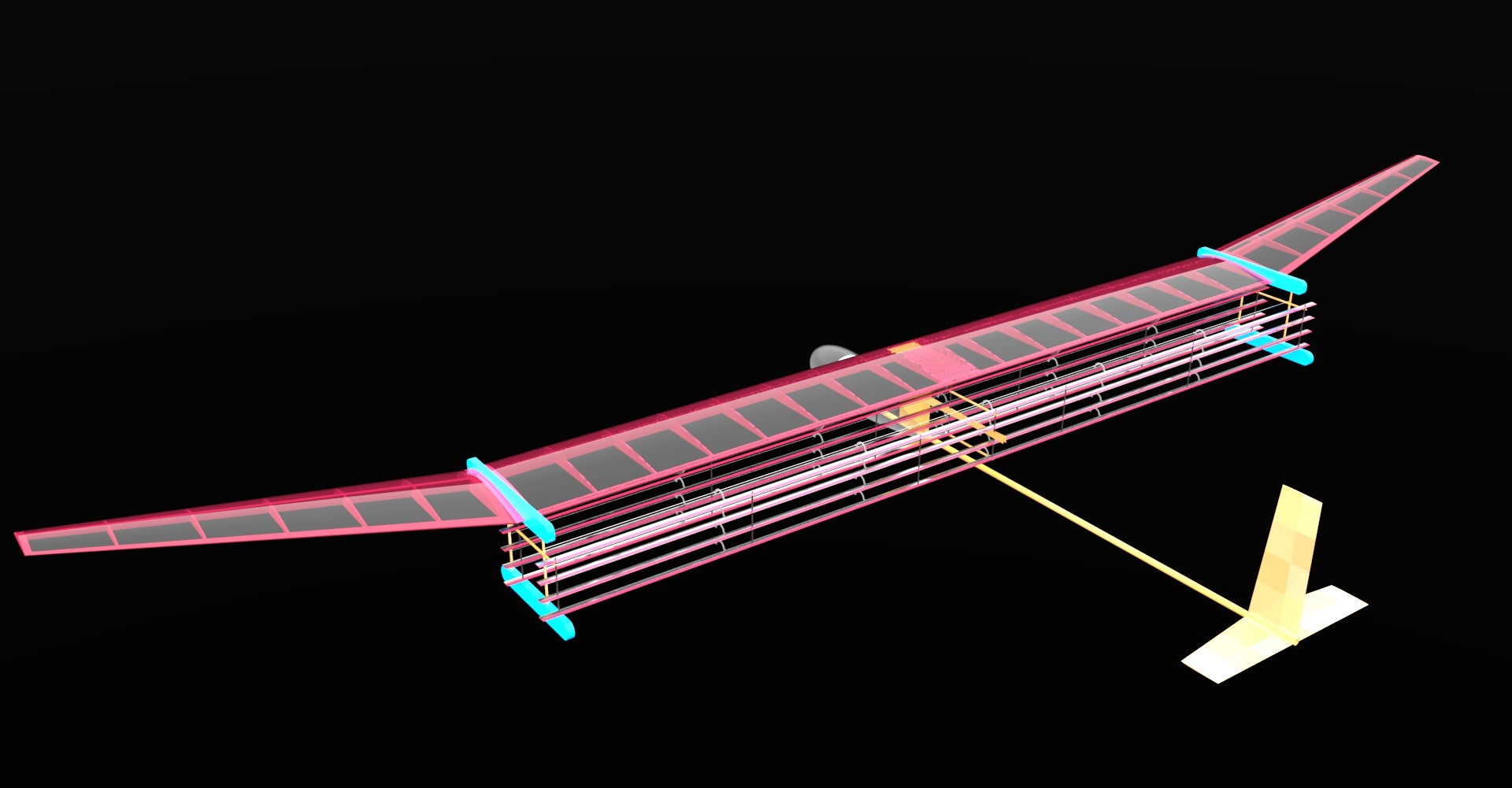
But Barrett and his team figured out three main things to make Version 2 work. The first was the ionic wind thruster design. Version 2’s thrusters consist of two rows of long metal strands draped under its sky blue wings. The front row conducts some 40,000 volts of electricity—166 times the voltage delivered to the average house, and enough energy to strip the electrons off ample nitrogen atoms hanging in the atmosphere.
When that happens, the nitrogen atoms turn into positively charged ions. Because the back row of metal filaments carries a negative charge, the ions careen toward it like magnetized billiard balls. “Along the way, there are millions of collisions between these ions and neutral air molecules,” Barrett notes. That shoves the air molecules toward the back of the plane, creating a wind that pushes the plane forward fast and hard enough to fly.
Another innovation Barrett’s team came up with was designing a lightweight but powerful electrical system, Walker notes. Before this aircraft, he says, nobody had created a system that could convert power from a lightweight battery efficiently enough to generate sufficient voltage for the thrusters. “The biggest challenge is [ion thrusters] need 20,000 or 30,000 volts just to work. High voltage on an aircraft doesn’t come easy,” he says. “You want to play with 40,000 volts on an aircraft? That technology didn’t exist. Steve [Barrett] found a clever way to get that efficient conversion.”
Finally Barrett used a computer model to get the most out of every design element in the aircraft, from the thruster and electrical system designs to the wires that ran through the plane. “The power converter, the battery, the caps and fuselage—everything was optimized,” Barrett says. “The simulations failed all the time. We had to make hundreds of changes.” In the end, they had the triumphant Version 2.
The breakthrough offers a great proof of concept showing ion thrusters can be used on Earth, says Alec Gallimore, an aerospace engineer at the University of Michigan who was not involved with the work. But any such use would likely be in limited capacities. Propellers and jets are still far more efficient than the ion wind thrusters Barrett demonstrated, making it unlikely that passenger planes would switch over anytime soon. But the thrusters have one key advantage: “There’s no sound generation.So [drones] for building inspections or things like that” would be an ideal application for these thrusters, Gallimore notes.
Or, Barrett adds, drones used for deliveries, filming or environmental monitoring. “Imagine 10 or 20 years from now—we could have drones everywhere,” he says. “If those are all noisy, they’ll degrade our quality of life. But this is silent.”