
Peer closely enough, and everything begins to look granular. Trees are made largely of quarks. Sunbeams are swarms of photons. Phones run on streams of electrons. Physicists have detected particles of matter, light, and most forces—but no experiment has yet unveiled gravity's grainy side.
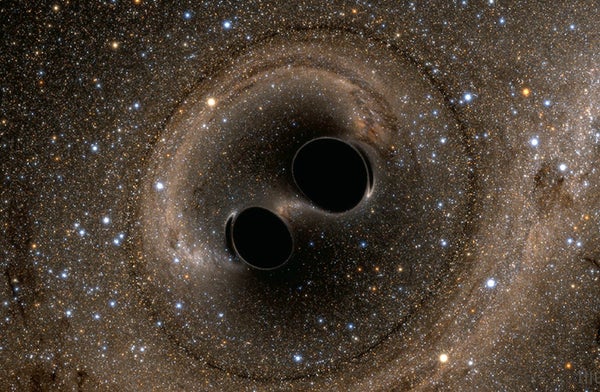
Many physicists assume that gravity must come in particles but that these massless “gravitons” interact with familiar particles too weakly to detect. To confirm the existence of gravitons, some theorists suggest searching for them when they gather in hordes surrounding intense gravitational events such as black hole mergers. A recent analysis, published in March in Physical Review Letters, hints that such violent cataclysms just might bring gravitons out of the shadows.
Where there is energy, there is gravity. And photons—massless packets of light energy—can, in exceedingly rare cases, spontaneously transform into gravity particles, according to Douglas Singleton, a physicist at California State University, who was not involved with the new study. The reverse happens, too, he says: gravitons can become photons. The new analysis considers a mechanism by which gravitons could unleash many billions of times more photons than earlier research suggested—making it easier to confirm their existence.
On supporting science journalism
If you're enjoying this article, consider supporting our award-winning journalism by subscribing. By purchasing a subscription you are helping to ensure the future of impactful stories about the discoveries and ideas shaping our world today.
“A primitive estimate based on intensities [of gravitons] in the vicinity of black hole mergers came close” to numbers that would produce detectable light, says Raymond Sawyer, the study's author and a physicist at the University of California, Santa Barbara.
Knowing from previous work that other massless particles can abruptly change state in large numbers (a phenomenon known as a quantum break), Sawyer consulted a computer model to see whether gravitons could follow the same pattern. His simulation suggests they do: when gravitons gather densely enough, eventually some of them turn into a burst of light particles. “It's like a storm building, with signs that are nearly invisible,” Sawyer says. “You don't see it until it happens.”
Events such as black hole mergers should create the necessary conditions to send out photons in the form of radio waves with wavelengths many kilometers long. This signal would be extremely faint but perhaps possible to pick up from Earth. Events somewhat more violent than previously observed mergers could do it, Sawyer says. Scientists would have to tease the glow of the resulting radio waves from that of interfering gases.
First, though, theorists must check if the model holds up. Sawyer hopes future simulations will prove that photon bursts also occur in more realistic models of intense gravitational events, where many gravitons swirl in intricate patterns. Singleton agrees that the problem needs more computational firepower: current analyses are “gross simplifications,” he says. “The idea is to get people interested enough to do the heavy calculations.”