
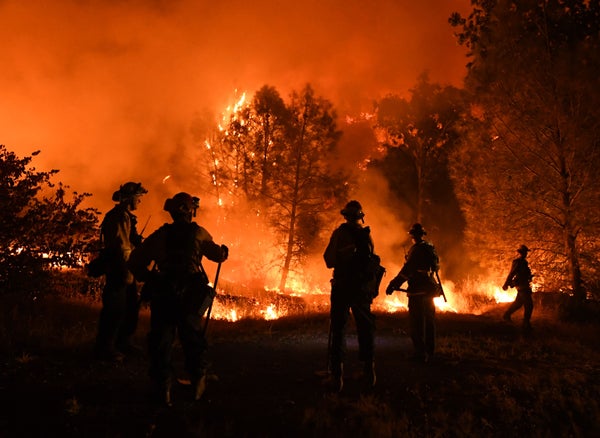
CLIMATEWIRE | Climate change is expected to help spark more simultaneous megafires in the western United States — a trend that could make it harder for firefighters to control the blazes.
That's according to a study published Aug. 1 in the International Journal of Wildland Fire. It projects increases in the number of simultaneous megafires — fires with a final burned area of 1,000 acres or more — in "every part of the Western USA at multiple return periods."
Simultaneous wildfires are more difficult to handle than a single wildfire, even if the total acreage is similar. That's because multiple wildfires can strain both time and resources.
On supporting science journalism
If you're enjoying this article, consider supporting our award-winning journalism by subscribing. By purchasing a subscription you are helping to ensure the future of impactful stories about the discoveries and ideas shaping our world today.
“Managing a bunch of fires is more complicated than managing a single fire, you don’t have limitless resources,” said Seth McGinnis, the study's lead author.
The study also expects there will be a longer period of time in which simultaneous megafires threaten the West.
"The length of the season of high simultaneity also increases everywhere and extends later into the year, most notably in the northern and eastern parts of the region, and especially in the Rocky Mountain" area, according to the study.
A longer season can impede wildfire suppression. Traditionally, fire officials use slow periods to set controlled fires called prescribed burns to suppress the fuel for future fires, McGinnis said. When they can't do that, the risk compounds.
In addition, states and countries often send firefighters to help out elsewhere when things are slow at home. This year, the United States sent 2,200 firefighters to Canada, one expert noted. Those exchanges, however, could become more limited as major wildfires grow more frequent.
“It’s a really difficult situation,” said Alison Cullen, a professor of environmental policy at the University of Washington and a co-author of the study. “Firefighters used to have a season when they were able to rest. That’s not happening anymore.”
Reprinted from E&E News with permission from POLITICO, LLC. Copyright 2023. E&E News provides essential news for energy and environment professionals.