
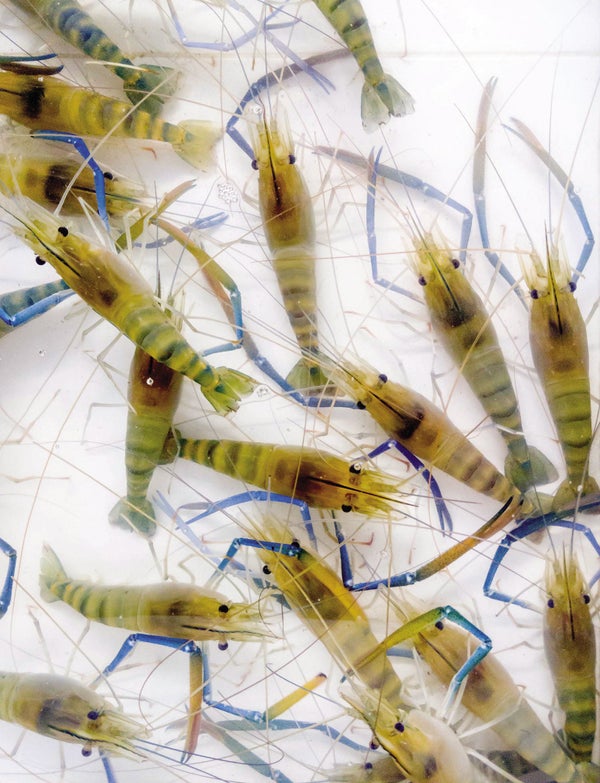
Scientists are mobilizing an all-female army to help stymie schistosomiasis, a sometimes deadly parasitic disease that affects millions of people every year.
Macrobrachium rosenbergii prawns “are voracious predators of parasite-carrying snails” that spread the illness, says Amir Sagi, a biologist at Ben-Gurion University of the Negev in Israel and principal investigator of a new study on the subject. “The possibility of nonreproducing monosex [prawn] populations, which will not become invasive, opens the path for their use as biocontrol agents.”
Using crustaceans to control Schistosoma-carrying snails is not a novel concept, but developing a sizable population that is all one sex and therefore cannot reproduce—and potentially ruin an ecosystem—has proved challenging.
On supporting science journalism
If you're enjoying this article, consider supporting our award-winning journalism by subscribing. By purchasing a subscription you are helping to ensure the future of impactful stories about the discoveries and ideas shaping our world today.
Like humans, prawns pass on specific chromosomes that determine their offspring's sex. But unlike humans, female prawns usually have one male and one female chromosome, whereas males have two identical male chromosomes. Laboratory-bred “superfemales,” each with two female chromosomes, can yield only female offspring—making them extremely useful in building a nonbreeding population.
Current methods to produce superfemales are inefficient. By implanting cells from a male's androgenic gland, Sagi and his colleagues sparked the transformation of superfemales physically into males, the first instance of male M. rosenbergii that completely lack male chromosomes. These prawns can then easily contribute their female chromosomes to new generations of superfemales. The process was detailed in August in Scientific Reports.
All-female prawn populations are particularly useful, scientists say. “Female prawns are more docile and less cannibalistic” than males, says Susanne Sokolow, a disease ecologist and veterinarian at Stanford University, who has worked with Sagi on related research. “They grow more evenly, potentially providing a more consistent product for harvest”—meaning local communities could use them for food, as well as snail control.
The snails that carry the schistosomiasis parasite live in southern and sub-Saharan Africa, parts of Southeast Asia, South America, the Middle East and some Caribbean islands. Within hours of touching snail-inhabited water, an infected person can suffer symptoms, including fever, cough, abdominal pain and diarrhea. The disease can also become chronic and lead to liver and kidney failure, bladder cancer and ectopic pregnancies. The World Health Organization reports that 220.8 million people required preventive treatment for schistosomiasis in 2017.
Deploying all-female prawns in addition to traditional disease treatment is an interesting strategy, but rigorous testing is needed, cautions David Rollinson, director of the Global Schistosomiasis Alliance, who was not involved in the study.
Rollinson says establishing the habitats in which the prawns could survive and determining how often more must be added should be top concerns. Sokolow adds that environmental ministries must coordinate on which types of monosex population they introduce. “Otherwise,” she says, “the environmental benefits to prevent local invasive establishment would be hard, if not impossible, to maintain.”