
Armed with a wand and funky spectacles, Beatrice Steinert steps into a world of lush green mounds and bright blue dots.
“To me, this is literally sitting right here,” she says, as she strokes something mid-air.
This is not some hallucinogenic trip. Rather, Steinert was exploring a microscopic snail embryo in 3-D at the YURT, a virtual reality theater at Brown University.
On supporting science journalism
If you're enjoying this article, consider supporting our award-winning journalism by subscribing. By purchasing a subscription you are helping to ensure the future of impactful stories about the discoveries and ideas shaping our world today.
For her undergraduate senior thesis here, she dove into the past and future of scientific imaging. She was drawn to how beautiful and abstract these illustrations can be.
“I try to use my artistic practice as a way to further investigate the methods of creating images that have been so important to science for a very, very long time,” Steinert said.
It lead her to a scientist named Edwin Grant Conklin.
Conklin was part of a group of scientists at the Marine Biological Laboratory in Woods Hole, Mass., who pioneered a line of research called cell lineage in the late 19th century.
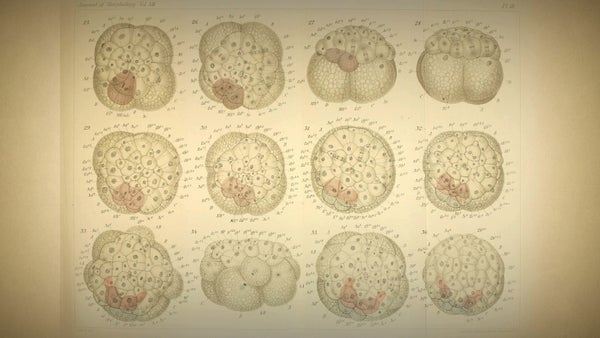
He focused on the embryos of a snail called Crepidula fornicata and traced parts like a foot, the mouth, and intestines to the earliest stages of cell division.
To do this, he had to collect embryos at different stages of development, drawing each of them by hand, piecing the cells together like a puzzle.
“It was incredibly time-consuming, incredibly meticulous, and difficult,” said Jane Maienschein, director of the Marine Biological Laboratory History Project. “It’s the kind of work that the people would not do today.”
Conklin, and later Steinert, used a camera lucida, an instrument that attaches onto the microscope, allowing viewers to trace what they see through the eyepiece.
“Because so many people used this, [I thought] it must be making it easier for people to draw,” Steinert said. “But when in fact, it constrains you in some ways and is not intuitive at all.”
Conklin’s work was published in 1897 in the Journal of Morphology with 105 hand-drawn images.
After recreating his study, Steinert said she has a clearer understanding of how he traced the cells, but she’s still left with many questions.
“There’s still an element of mystery to me on how he was able to follow these cells all the way through, and how he was able to retroactively go back and assign these identities,” she said. “It just seems impossible without some of the modern tools we have now to track cell lineages.”
Republished with permission from STAT. This article originally appeared on February 22, 2017