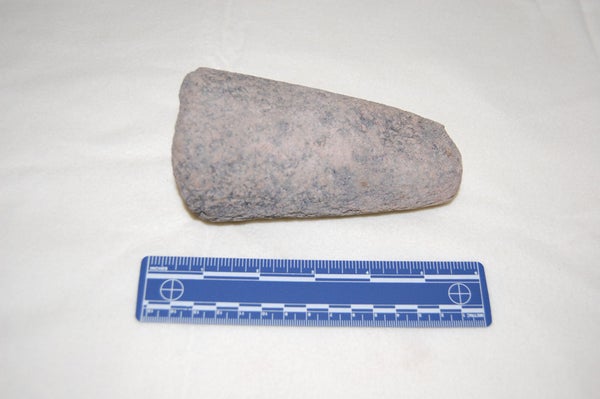
Slaves' possessions unearthed from an 18th-century plantation greenhouse

In 1785, as an unknown African slave built the furnace for a plantation's greenhouse, he packed in this prehistoric pestle among the bricks.

University of Maryland

Join Our Community of Science Lovers!


On supporting science journalism

If you're enjoying this article, consider supporting our award-winning journalism by subscribing. By purchasing a subscription you are helping to ensure the future of impactful stories about the discoveries and ideas shaping our world today.


In 1785, as an unknown African slave built the furnace for a plantation's greenhouse, he packed in this prehistoric pestle among the bricks. The object is a West African spirit practice symbol, University of Maryland archaeologist Mark Leone said in a prepared statement. University of Maryland archaeologists are excavating the grounds of the Wye House outside of Annapolis, Maryland. The house is known for its beauty—and for being a plantation where abolitionist Frederick Douglass was enslaved as a boy in the 1820s. The house and garden, where the greenhouse stands, appear in Douglass's autobiography: "Colonel Lloyd kept a large and finely cultivated garden, which afforded almost constant employment for four men," he wrote. "To describe the wealth of Colonel Lloyd would be almost equal to describing the riches of Job."

Now, urban archaeologists are unearthing the possessions of the slaves whose labors created that fabulous wealth. The researchers announced their greenhouse findings on February 14. In the same room as the West African pestle, they found pottery, coins and religious charms, which indicate that slaves lived in the greenhouse. The slaves constantly tended the plants and the complex furnace system, which warmed the greenhouse from under its floor.

—Francie Diep

It’s Time to Stand Up for Science

If you enjoyed this article, I’d like to ask for your support. Scientific American has served as an advocate for science and industry for 180 years, and right now may be the most critical moment in that two-century history.

I’ve been a Scientific American subscriber since I was 12 years old, and it helped shape the way I look at the world. SciAm always educates and delights me, and inspires a sense of awe for our vast, beautiful universe. I hope it does that for you, too.

If you subscribe to Scientific American, you help ensure that our coverage is centered on meaningful research and discovery; that we have the resources to report on the decisions that threaten labs across the U.S.; and that we support both budding and working scientists at a time when the value of science itself too often goes unrecognized.

In return, you get essential news, captivating podcasts, brilliant infographics, can't-miss newsletters, must-watch videos, challenging games, and the science world's best writing and reporting. You can even gift someone a subscription.

There has never been a more important time for us to stand up and show why science matters. I hope you’ll support us in that mission.

Thank you,

David M. Ewalt, Editor in Chief, Scientific American

Subscribe