
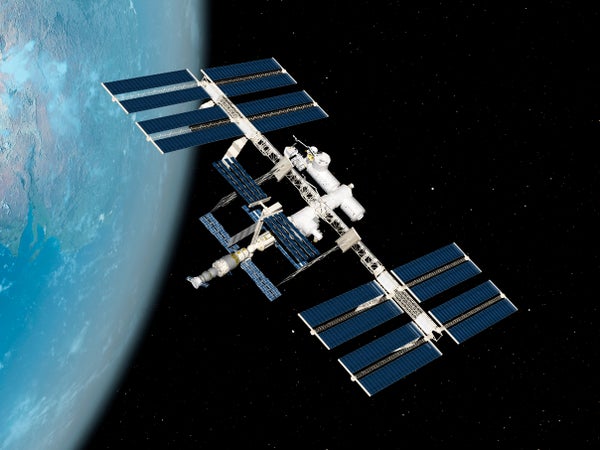
A small air leak was detected on the International Space Station Wednesday night (Aug. 29) but does not pose an immediate danger to the astronauts currently living aboard the orbiting laboratory.
Flight controllers on Earth began to notice signs of a slight pressure drop in the orbiting laboratory around 7 p.m. EDT (2300 GMT), while the six crewmembers of Expedition 56 were sleeping, NASA officials said in a statement today (Aug. 30).
Because the pressure loss was “very small,” flight controllers determined that the astronauts and cosmonauts “are in no danger,” officials with the European Space Agency (ESA) said in a separate statement. [Expedition 56: The Space Station Mission in Photos]
On supporting science journalism
If you're enjoying this article, consider supporting our award-winning journalism by subscribing. By purchasing a subscription you are helping to ensure the future of impactful stories about the discoveries and ideas shaping our world today.
After the crew awoke today, flight controllers at NASA’s Johnson Space Center in Houston and the Russian Mission Control Center near Moscow alerted them to the problem so the astronauts could begin working to pinpoint the leak’s location. They determined that the leak is in the Russian segment of the space station, but the exact module and cause have not been identified, NASA officials said.
“The crew are healthy and safe with weeks of air left in the International Space Station reserves,” ESA officials said in their statement. Additional updates will be posted on NASA’s International Space Station blog as more information becomes available, NASA spokesperson Dan Huot told Space.com in an email.
This is not the first time a small leak has sprung up on the space station, which has been continuously inhabited by rotating crews since 2000. Another leak occurred in the station’s Harmony module (which is located on the U.S. segment) in 2007 during Expedition 16. NASA officials said at the time that this leak was no cause for concern.
The station’s current Expedition 56 crew includes NASA astronuats Drew Feustel, Serena Auñón-Chancellor and Ricky Arnold; Russian cosmonauts Oleg Artemyev and Sergei Prokopyev; and German astronaut Alexander Gerst, of the European Space Agency. Feustel commands the crew.
Copyright 2018 SPACE.com, a Purch company. All rights reserved. This material may not be published, broadcast, rewritten or redistributed.