
On supporting science journalism
If you're enjoying this article, consider supporting our award-winning journalism by subscribing. By purchasing a subscription you are helping to ensure the future of impactful stories about the discoveries and ideas shaping our world today.
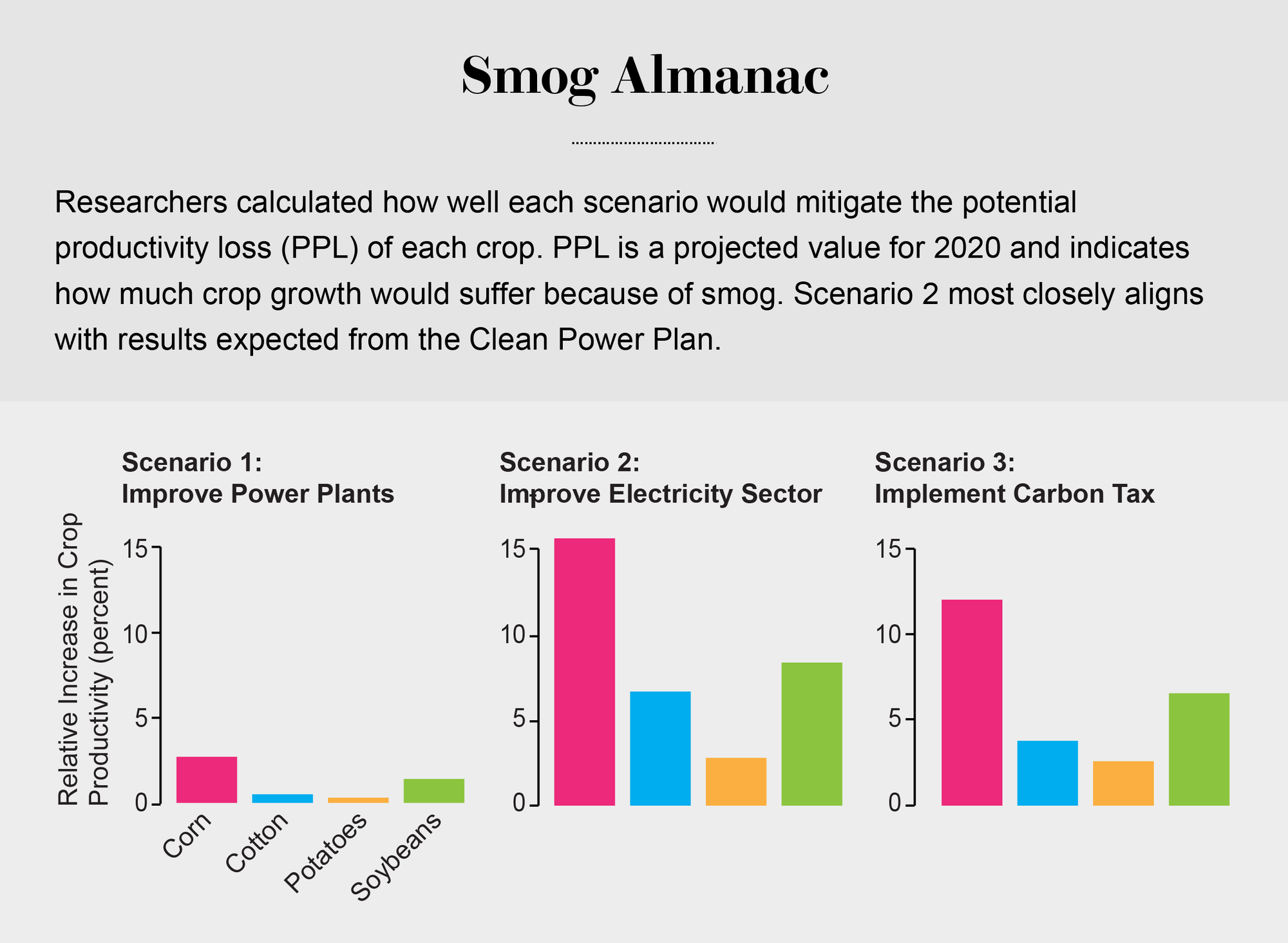
Nearly 20 U.S. states have started implementing former president Barack Obama's Clean Power Plan, which places limits on carbon dioxide emissions from power plants in an effort to reduce the impacts of climate change. The plan has been in legal limbo for the past year. Yet scientists have now calculated another outcome of the policy: harm to crop yields if the plan is scrubbed. Along with carbon pollution, coal-fired power plants spew pollutants that form ground-level ozone, or what we know as smog. The contribution of smog to increased rates of asthma and premature deaths was already known. The new research estimates the extent to which smog, under air-pollution policies in place before the Clean Power Plan, would limit production in 2020 of four major crops: corn, cotton, potatoes and soybeans.
Led by environmental engineer Shannon L. Capps, now at Drexel University, the team also sketched the extent to which those crop production losses would shrink under three nationwide counterscenarios. One improved the efficiency of individual power plants. Another modeled a policy similar to the Obama plan, setting state CO2 emissions goals for the electricity sector. A third established a tax on carbon emissions, under which emissions fell the most. But the greatest drop in smog-forming pollutants—and greatest gains in crop yields—came from policies such as the Clean Power Plan.
Credit: Amanda Montañez; Source: “Estimating Potential Productivity Cobenefits for Crops and Trees from Reduced Ozone with U.S. Coal Power Plant Standards,” by Shannon L. Capps et al., in Journal of Geophysical Research: Atmospheres, Vol. 121, No. 24; December 27, 2016