
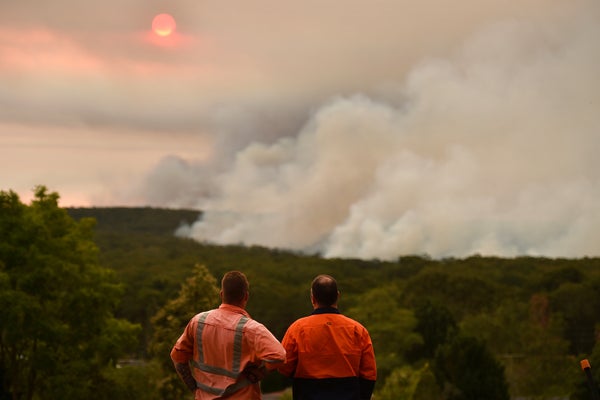
Smoke from Australia’s disastrous bush fires killed hundreds of people and sent thousands to hospitals and emergency rooms, according to a new study.
The estimated death toll does not include fatalities resulting directly from the flames that spread across much of eastern Australia late last year.
A research letter made public yesterday in the Medical Journal of Australia finds that at least 417 people died from smoke inhalation.
On supporting science journalism
If you're enjoying this article, consider supporting our award-winning journalism by subscribing. By purchasing a subscription you are helping to ensure the future of impactful stories about the discoveries and ideas shaping our world today.
Bush fire smoke also sent over 3,000 people to hospitals for cardiac and respiratory problems and forced more than 1,300 to emergency rooms for asthma attacks.
“The calculation does not include direct injuries or fatalities from the fire fronts,” said Fay Johnston, a researcher at the University of Tasmania. “We used known relationships between air pollution and increases in the health conditions and deaths to arrive at our estimate.”
The unprecedented bush fire season has been linked to global warming as record heat and dry conditions preceded the outbreak. The study suggests that rising temperatures are having a profound impact on the health of the country’s population.
More aggressive adaptation measures in Australia are required to protect the public from future climate-related disasters, the researchers argue.
“Smoke is just one of many problems that will intensify with the increasing frequency and severity of major bushfires associated with climate change,” the authors wrote. “Expanded and diversified approaches to bushfire mitigation and adaptation to living in an increasingly hot and fire-prone country are urgently needed.”
The research team, composed of scholars from the Australian states of Tasmania and New South Wales, says the spike in deaths and hospitalizations in regions affected by smoke can be mainly attributed to fine particulate matter. The highest level of particulate matter exposure recorded during the fire emergency exceeded the historic mean value by more than 14 times, the paper notes.
The authors caution that their study does not include data for the entire country, only for four states on Australia’s east coast.
Reprinted from Climatewire with permission from E&E News. E&E provides daily coverage of essential energy and environmental news at www.eenews.net.