
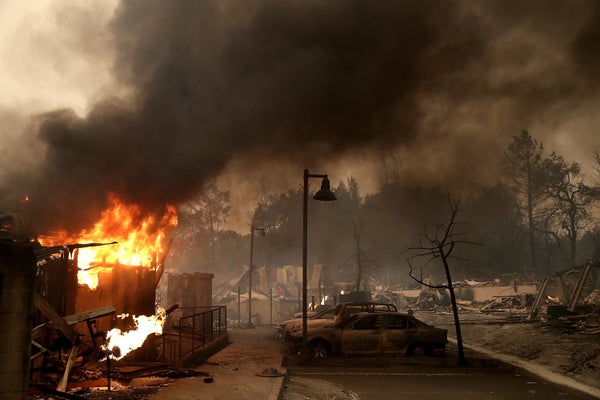
Devastating fires continue to spread through northern California’s wine country, claiming dozens of lives (with hundreds still missing), and destroying many homes and buildings. Along with these tragic losses, the fires and the smoke they produce may also threaten some of the area’s famous—and economically crucial—wine grapes and vineyards.
With fires still burning, it is too early to fully assess the damage. But much of the grape crop that has not been harvested could potentially be contaminated by smoke wafting into vineyards, where it can be absorbed by the plants. This may impart a foul, ashy taste known in the industry as “smoke taint,” says James Harbertson, an associate professor of enology (the study of wine and winemaking) at Washington State University.
The timing of the fires may have prevented the worst of the damage, says John Aguirre, president of the California Association of Winegrape Growers. In Napa and Sonoma counties, which account for about one fifth of the total wine grape acreage in the state (and some of its most valuable), between 80 and 90 percent of the grapes have already been harvested. Therefore, smoke will not be a huge issue for the state’s 2017 vintage, says Gladys Horiuchi, a spokesperson for the Wine Institute in San Francisco.
On supporting science journalism
If you're enjoying this article, consider supporting our award-winning journalism by subscribing. By purchasing a subscription you are helping to ensure the future of impactful stories about the discoveries and ideas shaping our world today.
But serious concerns remain. Economic losses from the smoke and the fires themselves could exceed $1 billion, including damage from wildfires that tainted wine grapes in Oregon and Washington State earlier in the year, Harbertson says. In 2016 California wines fetched $34.1 billion retail and helped lure more than 23 million tourists to the region, according to the Wine Institute. “The damage from the latest wildfires has been devastating and beyond what people could have anticipated,” he says. It has “destroyed [or killed] people, animals, vineyards, wineries, homes and businesses. It’s terrible.”
Little is known about exactly how smoky odors make their way into grapes and stick around during the winemaking process. Adding to the mystery is that smoky notes cannot always be tasted in the grapes themselves—but they still sometimes find their way into the finished product. Recent research, however, helps explain what is going on. In a study published in July in the Journal of Agricultural and Food Chemistry, Wilfried Schwab, a food chemist at the Technical University of Munich, and his colleagues identified a class of grapevine enzymes called glycosyltransferases that binds smoke molecules to sugars in the grapes. This creates chemicals called glucosides that are initially difficult to taste but can be broken down by yeast during fermentation and natural aging processes, freeing the ashy notes and ruining the wine.
The discovery points to some possible fixes: One strategy would be to breed or isolate strains of yeast that leave the glucosides intact. Another would be to develop a chemical that deactivates glycosyltransferases and could be sprayed on vines. This would prevent sugars from binding to and locking up the acrid flavors within the plant, says Markus Herderich, a scientist with The Australian Wine Research Institute, who was not involved in the Munich work. Scientists might also be able to find strains of grape with low natural levels of glycosyltransferases—or even to genetically engineer plants that lack such chemicals.
As for treating grapes that have already been damaged by smoke, there are few good options. Winemakers can limit contact time between the grape skins and the juices, which may reduce the amount of smoky notes that enter the wine, says Anita Oberholster, a researcher at the University of California, Davis. Using yeast strains to maximize the fruity characters in the wine and employing oak chips to “enhance the complexity of the wines” may also “decrease the perception of smoke-related attributes,” she adds. But grapes that encounter heavy smoke are often considered a total loss.