
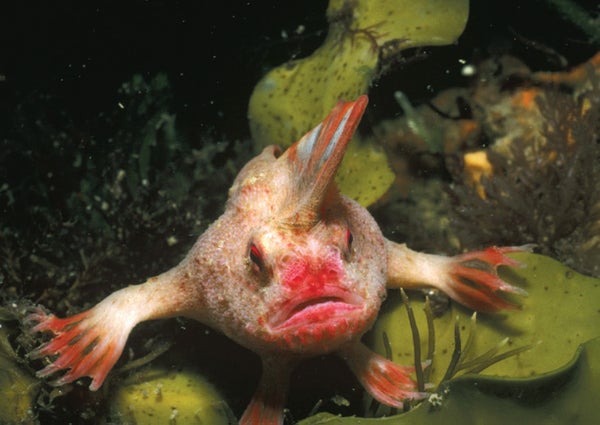
For centuries humans believed the ocean was so vast that it was impossible to do it measurable harm. But we now know human activities can destroy critical marine habitats, dangerously pollute seawater and make sea environments more acidic. Overharvesting has disrupted food chains and directly pushed many ocean species into the critically endangered category—and has driven some animals, including Steller's sea cow, into total extinction. This past March the smooth handfish, Sympterichthys unipennis, officially became the first modern-day marine fish to be declared extinct.
Handfish are a family of 14 unusual bottom-dwelling species related to deep-sea anglerfish. Unlike most other fishes, they do not have a larval phase and do not move around very much as adults; these traits make them sensitive to environmental changes, according to Graham Edgar, a marine ecologist at the University of Tasmania. “They spend most of their time sitting on the seabed, with an occasional flap for a few meters if they're disturbed,” Edgar says. “As they lack a larval stage, they are unable to disperse to new locations—and consequently, handfish populations are very localized and vulnerable to threats.” In 1996, he adds, another species called the spotted handfish was the first marine fish listed as critically endangered on the International Union for Conservation of Nature (IUCN) Red List.
The smooth handfish was once common enough to be one of the first fish species described by European explorers in Australia. Now none has been reported in well over a century, despite frequent scientific sampling in its known range (including by Edgar and his colleagues). Red List guidelines officially define “extinct” as meaning “there is no reasonable doubt that the last individual has died.” Edgar and the members of Australia's National Handfish Recovery Team were forced to that conclusion earlier this year, and the Red List placed it in the extinct category. Scientists are unsure exactly what finished off the species, but others in the region are threatened by trawl fishing, pollution and climate change.
On supporting science journalism
If you're enjoying this article, consider supporting our award-winning journalism by subscribing. By purchasing a subscription you are helping to ensure the future of impactful stories about the discoveries and ideas shaping our world today.
Edgar says additional marine fish species may already be extinct as well, although scientists cannot yet make the call. Many more are critically endangered. “It might be hard to imagine why a little organism occupying a small niche in a place few humans ever visit might be important—but it's an enzyme from an extremophile microbe that's being used in tests to diagnose COVID-19 right now,” says Katie Matthews, chief scientist for the nonprofit conservation group Oceana. “Biodiversity matters, even if you can't see it with your own eyes.”
Ideally, this news will be a sad wake-up call: “Some remaining species of handfish are endangered,” Matthews says, “but with smart action, we can mitigate those threats.”