
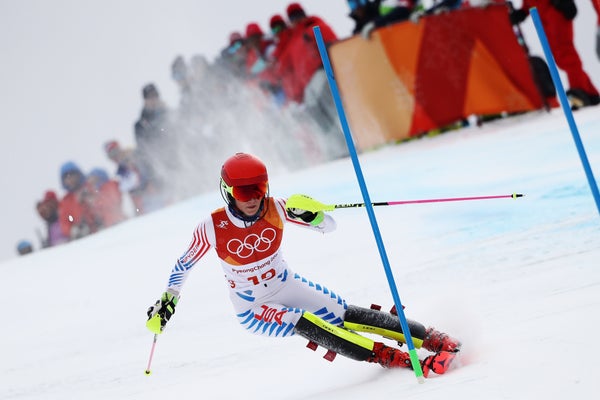
Early specialization—encouraging kids to focus on mastering a single activity from a very early age—is a striking trend in today’s culture. Replacing Tiger Woods, the current poster child for this approach to training is the skier Mikaela Shiffrin, winner of the Olympic gold medal in the giant slalom earlier this month. Reading books such as Daniel Coyle’s The Talent Code, which argues that the idea of natural-born talent is a myth, Shiffrin’s parents developed a plan to gradually improve her skill. Shiffrin was on skis at age 2, and her life has revolved around skiing ever since.
The logic of early specialization is straightforward: Training is necessary to develop skill, but there is a limit to how much a person can train, not just because there are only 24 hours in a day, but because training is physically and psychologically exhausting. A person can train intensively for only a few hours a day without injuring themselves or getting burned out. Thus, the child who starts training early will have a virtually insurmountable training advantage over the child who starts later. Training is, of course, necessary to develop skill. However, the findings of a study recently published in the Journal of Sports Sciences show that later specialization may actually lead to better performance in the long-term.
Professor Arne Güllich, director of the Institute of Applied Sport Science at the University of Kaiserslautern in Germany, compared the training histories of 83 athletes who medaled in the Olympics, or a World Championship event, to those of 83 athletes who competed at that level but did not medal. (The groups were matched on age, gender, and sport to control for any influence of these factors on the results. For every medalist in a given event, the sample included a non-medalist in that event of the same gender and roughly the same age.) The results showed that both the medalists and non-medalists started practicing in their main sport before the age of 12. However, the medalists started training in their main sport an average of 18 months later than the non-medalists. (The medalists started at age 11.8, on average, compared to age 10.3 for the non-medalists.) The medalists also accumulated significantly less training in their sport during adolescence and significantly more training in other sports. This pattern of results held across a wide range of sports, from skiing to basketball to archery.
On supporting science journalism
If you're enjoying this article, consider supporting our award-winning journalism by subscribing. By purchasing a subscription you are helping to ensure the future of impactful stories about the discoveries and ideas shaping our world today.
Along with reducing the risk of burnout and injury, allowing children to sample a range of activities before specializing allows a process known as gene-environment correlation to operate to its full extent. This is the idea that our genetically-influenced traits have an influence on the environments that we seek out and create for ourselves. As recently argued by the behavioral geneticist Elliot Tucker-Drob, gene-environment correlation is fundamental to understanding how expertise develops in children. For example, given the opportunity to try several sports, a child may discover that she has a high level of physical endurance and gravitate towards soccer because it places a premium on this attribute. She may also prefer soccer over other sports because she is extroverted and enjoys having teammates. In turn, after some initial success in the sport, the child’s coach may encourage her to continue playing soccer, setting in motion a “virtuous cycle” of effort followed by improvement, followed by further effort and improvement. However, this natural selection process will never unfold if the child isn’t given ample opportunity to try several sports before specializing.
A likely reason why the early specialization approach has become so popular is that stories like those of Tiger Woods and Mikaela Shiffrin are so compelling. These anecdotes reinforce the belief that practically anyone can become a champion with the “right” environment. At the same time, it is possible that Woods and Shiffrin just happened to specialize in the “right” sport—one that matched their penchants and preferences. In other words, where the selection of a sport was concerned, they may have gotten lucky. Had they chosen another sport, they may not have been nearly so successful.
Anecdotes are inadequate to make sound decisions about how best to train kids in sports and other activities. What is needed—and what is emerging through research by Arne Güllich and other sports scientists—is a body of empirical evidence that parents, teachers, and coaches can use as a basis for making decisions that will not only help youth reach the highest level of performance they can, but also maximize their enjoyment and minimize the risk of a host of negative outcomes.