
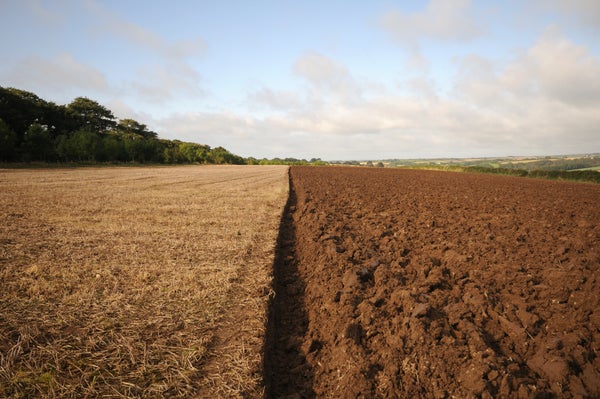
One of the world’s biggest carbon reservoirs is also one of the least glamorous: the dirt beneath our feet.
Soil all over the world probably contains more than 2 trillion tons of stored carbon, scientists estimate. That’s at least three times more than there is floating around in the Earth’s atmosphere.
Whether it will stay there is a big question.
On supporting science journalism
If you're enjoying this article, consider supporting our award-winning journalism by subscribing. By purchasing a subscription you are helping to ensure the future of impactful stories about the discoveries and ideas shaping our world today.
Recent research suggests climate change may play a growing role. As the world grows warmer and wetter, some scientists believe more carbon may exit the soil and move into the atmosphere. That could hasten the pace of climate change.
Like other natural pools of carbon—forests, wetlands and the oceans—soil has the potential to absorb carbon from the air or release its own carbon back into the atmosphere, depending on environmental conditions.
Major disturbances, like clearing land for agriculture, can unleash huge volumes of stored-up soil carbon. At least one study, published in 2017, suggested that agriculture has released around 133 billion tons of soil carbon over the last 12,000 years. Around half of those losses probably happened in the last few centuries alone.
Scientists increasingly believe climate change is also a threat.
Recent research indicates that warming causes some soils to lose carbon at faster rates. Scientists believe that as temperatures rise, they cause certain microbes in the soil to become more active. These microbes chomp down on organic matter and release carbon in the process.
Now, a new study suggests a wetter climate may also speed this process.
Published this week in Nature, the study looks at long-term records from India’s Ganges-Brahmaputra river basin stretching back nearly 20,000 years. During wetter periods in the region’s history, it maintains, the soil carbon turnover rate increased.
That suggests more carbon was going into the atmosphere instead of staying locked in the ground.
To conduct their analysis, the researchers—led by Christopher Hein of the Virginia Institute of Marine Science—collected samples of ancient sediments drilled out of the earth. They conducted carbon-dating analyses to determine the age of the carbon inside the sediments and whether the age of the carbon changed at different points throughout history.
Older carbon, during any given stretch of time, would suggest that the carbon is staying stored in the ground for longer periods of time. Younger carbon suggests that it’s “turning over” at a faster rate. The older carbon is being released into the atmosphere, while younger sources of carbon—from falling leaves or dying organisms, for instance—replace it.
In climate projections, the future of precipitation is a thorny question. Models generally suggest some parts of the world will become drier and others will become wetter. And in some cases, it may be some of both—some places may see an increase in both extreme droughts and extreme rainfall events, alternating in time.
Furthermore, the new study only looks at one location over thousands of years. It’s not necessarily clear that other regions will behave the same way or that the same location will respond similarly today.
But it may constitute a red flag—something for scientists to start examining more seriously. If the study is on the right track, it could point toward another potential climate feedback, where climate change causes natural landscapes to emit more carbon into the atmosphere, thus contributing to even more climate change.
At the same time, there’s growing evidence that warming may be an issue for soil carbon as well.
One of the world’s longest-running climate experiments, a 26-year study in a Massachusetts forest, tested plots of soil to find out how they responded to higher temperatures. Plots warmed by 5 degrees Celsius seemed to lose carbon in phases—a sudden release, followed by a temporary stabilization, followed by another release, and so on.
The researchers believe this stepwise response probably reflects the way microbial communities shift and adapt to environmental change. Heated plots lost about 17% of the carbon in their uppermost soil layers, although it’s worth noting that they were subjected to fairly extreme levels of warming.
Another long-term study, conducted over two decades in a Colorado meadow, also suggested that warming has some effect. In the warmer plots, where soil temperatures were typically about 1 C higher than the unwarmed plots, carbon declined in one layer of the soil.
Other, shorter-term studies have also indicated that warming has an effect. On the other hand, a 20-year experiment on the Arctic tundra found no change in soil carbon stores.
So there’s still debate about the exact effects of climate change on soil carbon, where those effects may be strongest and how much warming—or precipitation—it takes to make a difference.
In general, natural climate feedbacks present a major uncertainty when it comes to future climate change. Scientists have similar questions about how the world’s forests or oceans may respond to continued warming and how much carbon they’ll absorb versus how much they’ll emit back into the atmosphere.
Better understanding these responses may help scientists make more accurate projections about climate change. And soil—as unglamorous as it is—may be a growing part of the puzzle, with billions of tons of carbon hanging in the balance.
Reprinted from Climatewire with permission from E&E News. E&E provides daily coverage of essential energy and environmental news at www.eenews.net.
