
By Stanley Carvalho
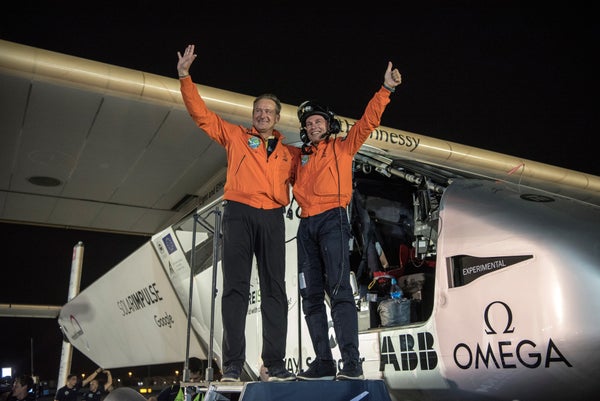
ABU DHABI (Reuters) - A solar-powered aircraft successfully completed the first fuel-free flight around the world on Tuesday, returning to Abu Dhabi after an epic 16-month voyage that demonstrated the potential of renewable energy.
The plane, Solar Impulse 2, touched down in the United Arab Emirates capital at 0005 GMT (0405 local time) on Tuesday.
On supporting science journalism
If you're enjoying this article, consider supporting our award-winning journalism by subscribing. By purchasing a subscription you are helping to ensure the future of impactful stories about the discoveries and ideas shaping our world today.
It first took off from Abu Dhabi on March 9, 2015, beginning a journey of about 40,000 km (24,500 miles) and nearly 500 hours of flying time.
Bertrand Piccard and Andre Borschberg, the Swiss founders of the project, took turns piloting the aircraft, which has a wingspan larger than a Boeing 747 but weighs no more than an average family car.
"More than an achievement in the history of aviation, Solar Impulse has made history in energy," Piccard, who piloted the plane on the last leg, told a large crowd on landing.
"I’m sure that within the next 10 years we’ll see electric airplanes carrying 50 passengers on short- to medium-haul flights," he said in a statement.
He said the technologies used on Solar Impulse 2 could be used on the ground in daily life to halve emissions of carbon dioxide, the main greenhouse gas blamed for climate change.
The propeller-driven aircraft's four engines are powered by energy collected from more than 17,000 solar cells built in the wings. Excess energy is stored in batteries.
Unfavorable weather at times hindered smooth flying, causing the plane to be grounded for months in some countries. In all, the plane had 16 stopovers.
The pilots also had to demonstrate the mental stamina required to tackle vast distances alone at a cruising speed of no more than 90 km (56 miles) per hour and altitudes of up to 9,000 meters (29,500 feet).
"We were facing the oceans... We had to build up this mindset, not just the plane and technology," Piccard told reporters.
For the two pilots, landing back where they started is only "the beginning of the continuation" of a longer journey, said Piccard, who in 1999 became the first person to circumnavigate the globe non-stop in a hot air balloon.
Aside from continuing to promote renewable energy, they plan to launch an international council to advise governments and develop new applications for clean energy technology.