
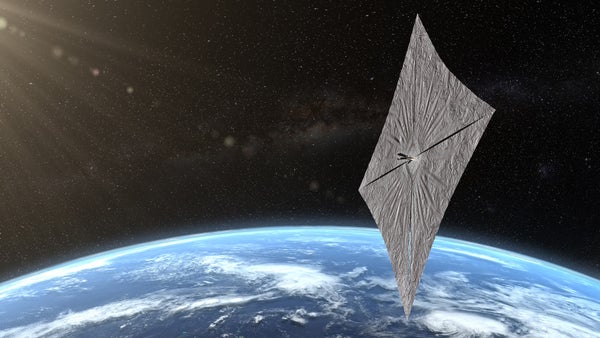
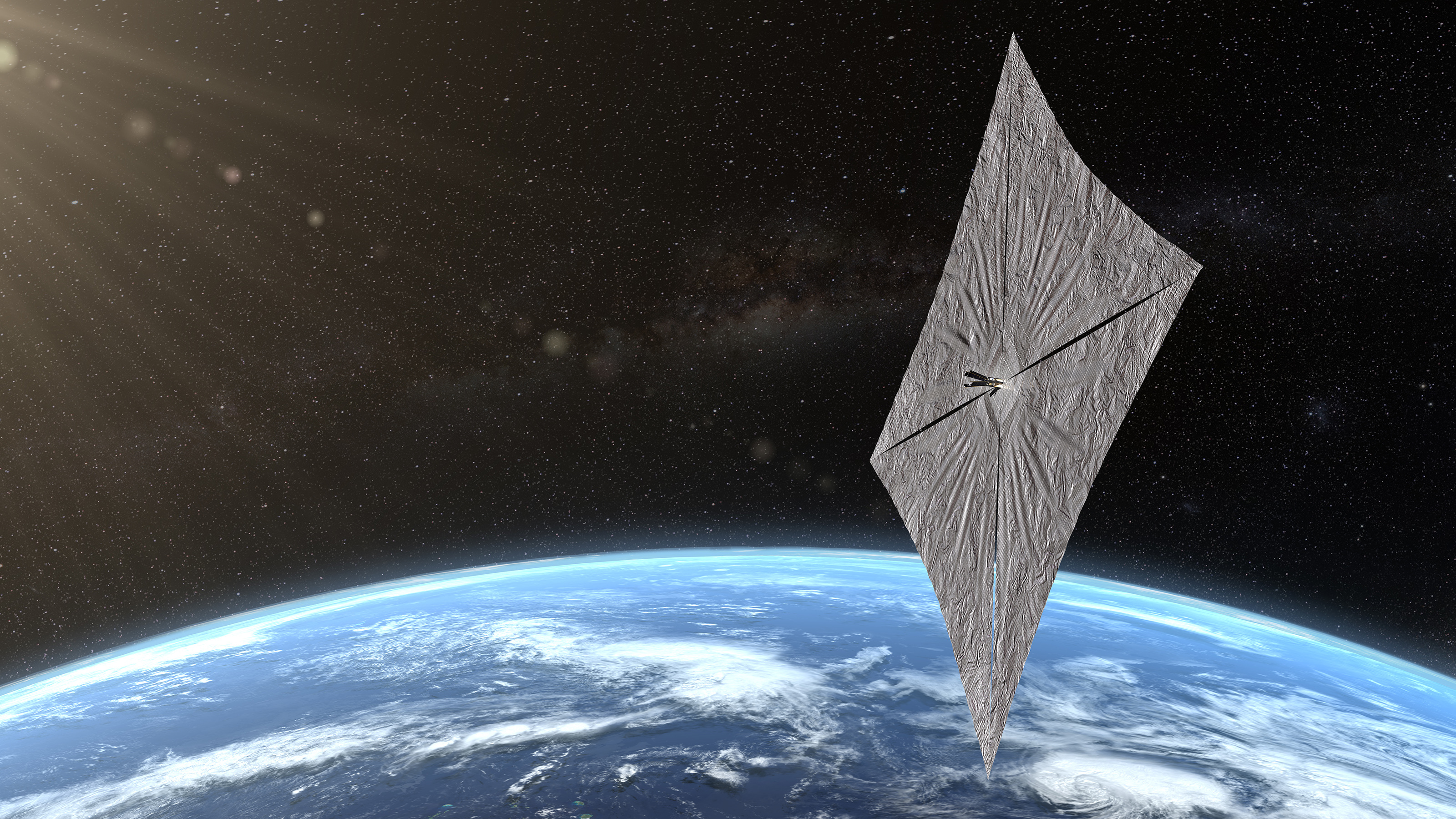
A square of silvery foil large enough to cover the floor of a boxing ring is now circling high above Earth. What it is about to do next may change the course of spaceflight.
The Planetary Society’s LightSail 2, now fully deployed, is the first spacecraft in Earth orbit to be propelled only by sunlight. Pushed by the momentum of photons striking its sail, the satellite, and the technology it demonstrates, could someday lead to revolutionary advances in interplanetary—even interstellar—exploration.
“It’s incredibly rare that one gets an opportunity to participate in the first stages of a new spacecraft-propulsion technology. There aren’t that many,” said Bruce Betts, chief scientist and LightSail 2 program manager at the Planetary Society, in a prelaunch phone call with reporters. “So being at the initial phases, [the] first steps of solar sailing, is quite an honor.”
On supporting science journalism
If you're enjoying this article, consider supporting our award-winning journalism by subscribing. By purchasing a subscription you are helping to ensure the future of impactful stories about the discoveries and ideas shaping our world today.
Packed inside a CubeSat the size of a loaf of bread, the 32-square-meter LightSail 2 launched with 23 other spacecraft onboard a SpaceX Falcon Heavy rocket from the Kennedy Space Center on June 25. Initially hitching a ride on one of those travel companions, LightSail 2 was deployed into a nearly circular orbit about 720 kilometers above Earth on July 2.
Initial system checks went well, including powering up and testing the on-board cameras and deploying the satellite’s four hinged solar panels. However, mission managers delayed solar-sail deployment by two weeks after receiving inconsistent readings from LightSail 2's magnetometers and “sluggish” performance from the spacecraft's electromagnetic torque rods, which are used to change the spacecraft's orientation.
After uploading a software patch and re-testing the attitude control system, the team was again ready to proceed. At 2:47 Eastern time on July 23, the big moment came—four cobalt-alloy booms extended like a tape measure, pulling with them four triangular Mylar sails.
The whole deployment took about three minutes. Soon, LightSail 2 will begin to live up to its name.
“We use the term boom just like on a sailboat, to hold the sails out, because we’re twisting relatively fast in Earth orbit,” explained Bill Nye, former host of Bill Nye the Science Guy and now CEO of the nonprofit Planetary Society, to the press before launch. “We go edge on toward the sun, twist 90 degrees, go face on and get a full push like a sailboat going downwind, building orbital energy. [We] then twist again on the night side of the Earth and twist on the day side, over and over.”
The push is very small. The total force is roughly the same as the weight of a housefly landing on your hand on Earth. But it is constant.
“It doesn’t sound like much, but it’s continuous,” Nye said. “It’s so different from what we’re used to in rocket science. You know Newton’s first law: things in motion tend to stay in motion.”
That is, an object will remain in motion if another force does not act upon it—which, in LightSail 2’s case, will happen.
Assuming everything goes as planned, the solar sail will raise LightSail 2 in its orbit about half a kilometer each day. But the small satellite’s attitude-control system is not capable of keeping it within a perfectly circular orbit. So while it will rise higher on one side of the planet, it will dip steadily lower on the other.
After about a month, atmospheric drag will overpower the solar sail, ending the test. LightSail 2’s fate is to burn up on reentry in about a year. But the spacecraft’s promise will extend far into the future.
As its name implies, LightSail 2 is not the first solar sail. The concept dates back to the late 17th-century German astronomer Johannes Kepler, who theorized that seagoing ships and sails could be “adapted to the heavenly breezes.” The first actual solar sail (which tacks into the sun’s light rather than its solar wind)wasdesigned by NASA nearly four centuries later as a possible way to intercept Halley’s Comet.
From its start in 1980, the Planetary Society had an interest in solar sailing, given the work of its three founders—the late Carl Sagan, the late Bruce Murray and Louis Friedman—in advancing the technology. In 2005 the organization attempted to launch its first solar sail, Cosmos 1, but its Russian launch vehicle failed to reach orbit.
The LightSail project began in 2009, a year before the Japan Aerospace Exploration Agency successfully deployed IKAROS, the world’s first spacecraft to demonstrate solar sailing, in the interplanetary space between Earth and Venus.
The Planetary Society’s LightSail 1, a technology demonstrator that did everything but sail, was launched in 2015. LightSail 2 now completes the organization’s goal to advance the concept.
“There’s no plan for LightSail 3. But that’s because we’re not a LightSail company,” the Planetary Society’s chief operating officer Jennifer Vaughn told reporters. “LightSail 3 is for other people to take on, not necessarily with that name. But what we try to do is get a technology ready to then hand off to the world, and then it [can] be implemented by others.”
NASA has plans to deploy a solar sail on Near-Earth Asteroid Scout, a CubeSat slated to lift off as soon as 2020 with the first Space Launch System rocket. LightSail 2’s success gives a boost to that mission and those to come after it.
“It’s really exciting to be flying this thing at last,” Nye said. “It’s almost 2020, and we’ve been talking about it for, well, for 40 years. It’s very, very cool.”