
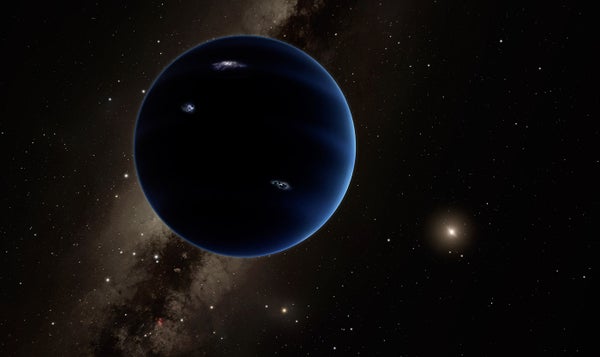
An analysis of four icy bodies discovered in the outer Solar System reveals no sign that they are being influenced by a large, unseen planet lurking beyond Neptune. The finding chips away at a line of evidence for a ‘Planet Nine’ proposed in 2014 on the basis of the clustering of objects in a region called the Kuiper belt, argues a team of astronomers in a paper first posted on the arXiv preprint server on June 16.
The objects were found by researchers leading the Outer Solar System Origins Survey (OSSOS), which is studying the region of space beyond Neptune. The bodies that piqued the astronomers’ interest dwell in the outer reaches of the Kuiper belt.
Using the 3.6-metre Canada-France-Hawaii telescope on Mauna Kea, Hawaii, the team found four bodies that orbit the Sun in enormous ellipses at least 250 astronomical units (au) wide. An au is equivalent to the distance between Earth and the Sun; Neptune orbits at around 30 au. About 12 large-orbit bodies have been spotted so far, including the four found by OSSOS.
On supporting science journalism
If you're enjoying this article, consider supporting our award-winning journalism by subscribing. By purchasing a subscription you are helping to ensure the future of impactful stories about the discoveries and ideas shaping our world today.
Arguments for Planet Nine are based on the clustering of six of those previously known large-orbit objects. Studies, by two other research teams, which drew on multiple astronomical surveys, found that the six bodies were arranged in two groups. Both teams suggested that the gravity of an unseen planet, perhaps ten times Earth’s mass, had shepherded the objects into those curious arrangements.
Disappearing clusters
Scientists agree that the astronomical surveys that spotted those six bodies weren’t perfect, says Cory Shankman, an astronomer at the University of Victoria in Canada and the lead author of the latest study. Each had to contend with reduced visibility due to bad weather in some seasons, and the fact that it’s easier to see Kuiper belt objects away from the plane of the Milky Way. Such factors can lead astronomers to spot more bodies in certain parts of the sky than in others, even when the objects are actually distributed evenly, says Shankman. It’s possible to account for such biases using statistical methods, but most of the previous surveys didn’t report doing so.
The OSSOS team argues that the biases could have led to false indications of clustering. “They were building this entire argument around six objects with unknown biases in how they were detected,” says astronomer Samantha Lawler at the National Research Council Canada in Victoria, “which is a very dangerous game to play.”
Three of the objects found by OSSOS appeared to be in the two previously identified clusters. But when the study authors accounted for the fact that their survey preferentially spotted bodies in certain parts of the sky at certain times of year, the evidence for clustering disappeared, says Shankman.
The case for Planet Nine
The unknown biases in previous surveys do weaken the case for a Planet Nine at the size and distance proposed, says Renu Malhotra, an astronomer at the University of Arizona in Tucson. However, she adds, the OSSOS team has not proved that these biases actually enhance the appearance of clustering among distant Kuiper belt objects, so its paper does little to change the debate.
Scott Sheppard, an astronomer at the Carnegie Institution for Science in Washington DC and part of the team that first suggested the presence of an unseen planet, agrees. Even with the new data, the best explanation for the odd grouping of Kuiper belt objects is a planet, he says.
And even if previous surveys had issues, they could still have spotted evidence for the existence of a massive planet, says Konstantin Batygin, an astronomer at the California Institute of Technology in Pasadena and a member of the other team that proposed the existence of Planet Nine.
Besides, clustering is only one line of evidence for Planet Nine, he says. Discoveries of Kuiper belt objects that aren’t tethered to Neptune, and others with orbits nearly perpendicular to those of most Solar System objects, are most easily explained by the presence of a large planet in the outer Solar System, Batygin adds.
What will ultimately resolve the Planet Nine question, says Malhotra, is more data from current and future telescopes. “We are really working at the margins of what’s technically feasible with the outer Solar System observations,” she says. “We’re really pushing the boundaries of what’s possible to detect.”
This article is reproduced with permission and was first published on June 22, 2017.