
Our immune system must recognize a microbe as potentially dangerous before it can react to it as a threat. To help do so, cells use special pattern-recognition receptors that broadly identify classes of microbes based on certain molecular structures.
One of these signature structures is lipopolysaccharide (LPS), a long chain of sugars anchored to the cell membranes of numerous bacteria types. Many researchers assumed our bodies could recognize a version of LPS produced by any microbe, except those of a few pathogens that specifically evolved to evade immune detection. But a new study reveals there are strains of deep-sea bacteria whose LPS is essentially invisible to our cells' pattern-recognition receptors.
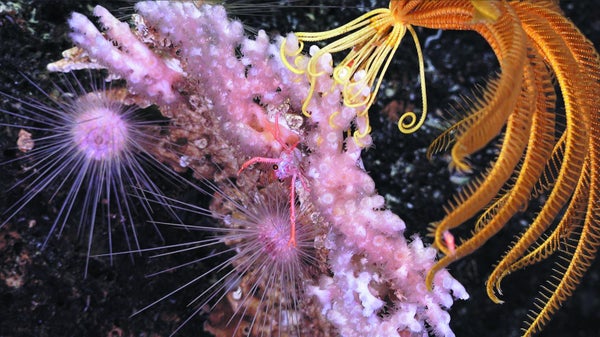
In 2017 a team of scientists set sail on the Schmidt Ocean Institute's research vessel Falkor for the Phoenix Islands Protected Area (PIPA) in Kiribati, one of the planet's largest marine conservation zones, located in the central Pacific Ocean. As part of their exploration of the largely untouched ecosystem, the researchers collected bacteria from as deep as 3,000 meters (nearly two miles) below the ocean's surface. They cultured 50 strains in an onboard laboratory and exposed each one to human and mouse immune cells in a dish. The immune cells recognized the LPS on a few of the new bacterial strains and reacted the way they would to ubiquitous bacteria such as Escherichia coli. But 80 percent of the deep-sea bacterial strains were completely unrecognizable to one or both of two LPS-detecting pattern-recognition receptors.
On supporting science journalism
If you're enjoying this article, consider supporting our award-winning journalism by subscribing. By purchasing a subscription you are helping to ensure the future of impactful stories about the discoveries and ideas shaping our world today.
“I think the paper is super exciting,” says University of Pennsylvania immunologist Sunny Shin, who was not involved in the study. She notes that the findings go against the prevalent understanding that these receptors can recognize any foreign microbe. Instead the research, published in Science Immunology, suggests that pattern-recognition receptors have evolved to reliably detect only microbes found in familiar environments.
“Our immune system certainly has a need to detect every microbe that we would see as we go to Starbucks,” says Boston Children's Hospital immunologist Jonathan Kagan, a study co-author. But it apparently does not detect at least some microbes that live in an environment we would never naturally encounter.
Does this mean we need to worry about deep-sea microbes overrunning our immune systems? Probably not. For one thing, bacteria that thrive in the cold, dark saltiness of the deep ocean are unlikely to do so inside our warm bodies. And the immune system has many other mechanisms for sensing invasive bacteria.
Nevertheless, this study could lead to interesting clinical applications. Researchers have long considered including LPS in vaccines to help kick-start the immune system—but it causes such a strong immune response that this can be dangerous. Although most of the Phoenix Islands' deep-sea bacteria had LPS varieties that triggered no response, some provoked a moderate one. Kagan says these new LPS molecules might potentially be used as a “dial” to let cancer vaccine researchers fine-tune immune responses, instead of just flipping a switch between zero and 10.
The deep ocean is not a traditional place for immunology research. This study emerged from a unique collaboration between Kagan, lab member Anna Gauthier and marine ecologist Randi Rotjan, who is co-chief scientist of PIPA. Rotjan had planned an exploratory expedition, and she invited Gauthier to collect and characterize deep-sea bacteria along the way.
The researchers are planning another cross-disciplinary expedition to PIPA next summer to investigate more targeted questions, including how native deep-sea organisms such as corals respond to their bacterial neighbors, Rotjan says. But the team is open to surprises, she adds: “That's the beauty of basic research—you never know where it's going to go.”
