
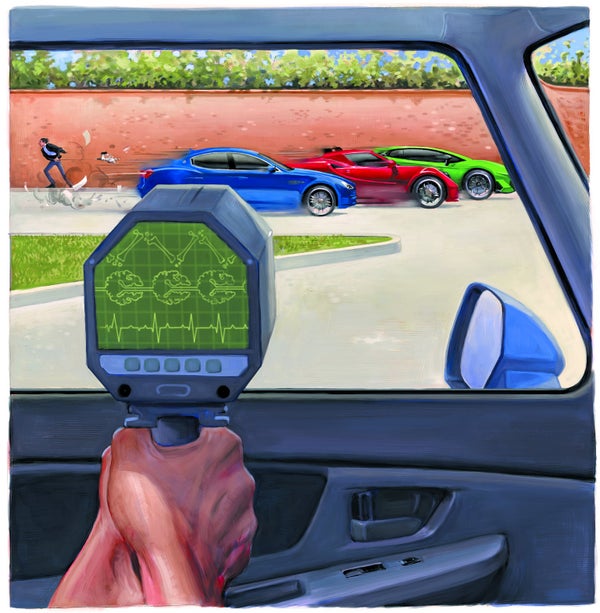
Medical doctors can have the letters “MD” on their cars’ license plates, which in some places can help them bend the rules regarding parking and speeding in emergencies. But if you’re at all like me—and for the sake of your loved ones, let’s hope you’re not—you have one of three highly prejudicial and unfair reactions when you see a car with MD license plates. For a fancy vehicle: Ooh, look at Mr. Big Shot driving a six-figure car. For a piece of junk: What kind of crummy doctor drives that piece of junk? For any other auto: “Emergency” my butt; you’re probably my dermatologist. (By the way, none of these opinions are in effect if the doctor is rushing to care for me.)
A logical follow-up question to the physician license-plate issue then is, Does a dermatologist drive differently than a surgeon? Finally, we have an actual scientific study to answer that vital question ... vital signs question ... vital road-signs question ... yeah, that’s it.
Anyway, the research, written up with the title “The Need for Speed: Observational Study of Physician Driving Behaviors,” is in the 2019 edition of the notorious Christmas issue of the BMJ, formerly called the British Medical Journal, even more formerly called the Provincial Medical and Surgical Journal upon its founding in 1840—and perhaps informally once called Gathering Around to See What Nigel Found While Digging Up Cadavers Weekly.
On supporting science journalism
If you're enjoying this article, consider supporting our award-winning journalism by subscribing. By purchasing a subscription you are helping to ensure the future of impactful stories about the discoveries and ideas shaping our world today.
Back to the BMJ article. The objective of the study was “to determine whether fast driving, luxury car ownership, and leniency by police officers differ across medical specialties.” At this point, I must note that the research was based on records of speeding tickets issued to almost 5,400 doctors who received some 15,000 tickets between 2004 and 2017 in the state of Florida. So take the location into account when considering these findings, because as I noted in the January issue while discussing rodents that were taught to drive tiny cars for science, “Video of the vehicular vermin can be found online, and, frankly, I’ve seen worse driving in Florida shopping center parking lots.”
The online article has a fun interactive feature that allows one to look at which specialists drive the fastest on average, get the most tickets for extreme speed (more than 20 miles per hour over the speed limit) and drive the most expensive cars, among other auto doc data. Given that you are clearly not looking at that interactive feature at the moment, I’ll summarize. But first: What’s an orthopod?
The online medical encyclopedia Gomerpedia defines “orthopod” thusly: “Often confused with an arthropod, an orthopod is a vertebrate animal with an endoskeleton that cares deeply about every [sic] else’s bones.” (“Gomer,” as is well known in the medical community, is an acronym for “get out of my emergency room,” as per the novel The House of God, by Samuel Shem, published in 1978.) And orthopods, also called orthopedists, are the fastest drivers. They are followed by psychiatrists. Paranoid orthopods only think they’re being followed by psychiatrists.
When it comes to getting caught driving more than 20 miles an hour over the limit, psychiatrists follow no one—they lead the pack. Second place in that category goes to general surgeons, who may reasonably be in a hurry to get to a patient in extremis. The rushing psychiatrists may simply be trying to get ahead of cardiologists, who have the priciest cars.
All of which reminds me: my father really did have a cardiologist who drove a Maserati. And that cardiologist was a woman. Which brings to mind another article in the same Christmas issue of the BMJ, entitled “Time’s Up for He and Him as the Default Pronouns for Doctors.” According to that piece, “most doctors are or will be women—our language should reflect that reality.”
So please revise my catty earlier remark about doctors who drive expensive cars so that it pertains to both Mr. and Ms. Big Shot. Better yet, just call them all “Doctor.”