
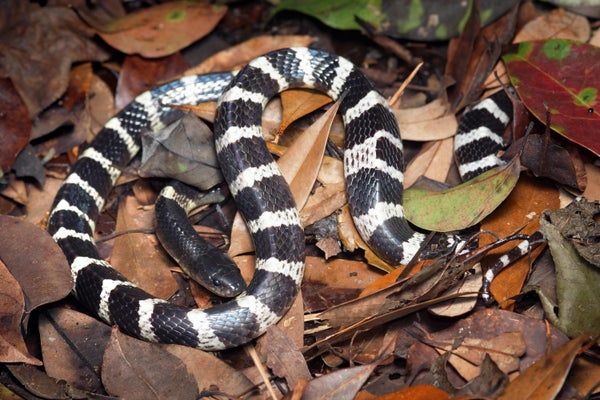
As human cases rise in a mysterious viral outbreak that originated in China, scientists are rushing to identify the animals, where they suspect the epidemic began. In a controversial study published last night, a team of researchers in China claimed to have an answer: snakes.
But other scientists say there is no proof that viruses such as those behind the outbreak can infect species other than mammals and birds. “Nothing supports snakes being involved,” says David Robertson, a virologist at the University of Glasgow, UK.
The pathogen responsible for the outbreak belongs to a large family called coronaviruses, which includes the viruses that cause severe acute respiratory syndrome (SARS) and Middle East respiratory syndrome (MERS), as well as those behind the common cold. The latest virus—currently known as 2019-nCoV—is most closely related to SARS and related viruses that circulate in bats. But these can also infect other animals that can pass the virus to humans. Many scientists suspect that an unknown animal carrying 2019-nCoV spread the virus to humans at a live seafood and wild animal market in Wuhan, where the first cases were documented in December.
On supporting science journalism
If you're enjoying this article, consider supporting our award-winning journalism by subscribing. By purchasing a subscription you are helping to ensure the future of impactful stories about the discoveries and ideas shaping our world today.
“The intermediate host is the missing piece of the puzzle: how have all these people got infected?” says Robertson.
Hedgehogs, chickens and bats
A team led by Wei Ji, a microbiologist at Peking University Health Science Center School of Basic Medical Sciences in Beijing, looked for a sign that 2019-nCoV had adapted to any specific animal host.
Most amino acids are encoded by multiple codons—sequences of three DNA or RNA nucleotide triplets that encode amino acids. One way that viruses adapt is by encoding proteins using the same choice of codons as their host. Wei’s team compared the codons favoured by 2019-nCoV with those preferred by potential hosts including hedgehogs, pangolins, bats, chickens, humans and snakes.
The team reported that 2019-nCoV’s choice of codons was most similar to those used by two snakes: Bungarus multicinctus (the many-banded krait) and Naja atra (the Chinese cobra). Snakes were sold at the Wuhan seafood and animal market, the researchers note. “Taken together, snakes could be the most likely wildlife animal reservoir for the 2019-nCoV,” they write in a paper published on 22 January in the Journal of Medical Virology.
Robertson says it’s unlikely that 2019-nCoV has infected any secondary animal host for long enough to alter its genome significantly. “It takes a long time for such a process to play out,” he says.
Evidence gap
“They have no evidence snakes can be infected by this new coronavirus and serve as a host for it,” says Paulo Eduardo Brandão, a virologist at the University of São Paulo who is investigating whether coronaviruses can infect snakes at all. “There’s no consistent evidence of coronaviruses in hosts other than mammals and Aves (birds).”
Wei’s team has not yet responded to e-mails from Nature’s news team seeking comment on the paper and the criticism it has received.
Many researchers are sceptical that the animal host or hosts of 2019-nCoV can be identified without further field and laboratory work. Many hope that genetic tests of animals or environmental sources, such as cages and containers, from the Wuhan market will turn up clues.
A mammal is the most likely candidate, says Cui Jie, a virologist at the Pasteur Institute of Shanghai who was part of a team that identified SARS-related viruses in bats from a cave in Yunnan province in southwestern China in 2017. SARS and 2019-nCoV are part of a virus subgroup known as betacoronaviruses. Fieldwork in the wake of the 2002–03 SARS outbreak has found such viruses only in mammals, Cui says. “Clearly this 2019-nCoV is a mammalian virus.”
This article is reproduced with permission and was first published on January 23 2020.