
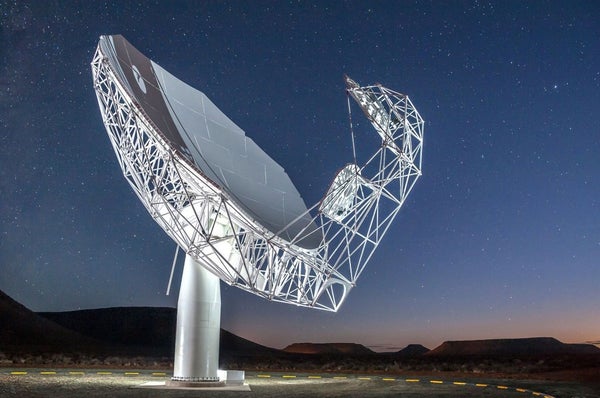
Scientists and politicians in South Africa are together celebrating the official opening of a gigantic telescope that is already transforming astronomy research in the nation.
A ceremony that was live-streamed on national television stations on 13 July from a remote site in Northern Cape province marked the completion of the powerful MeerKATT radio telescope, which was designed in, and funded by, South Africa.
An array of 64 dishes, each 13.5 metres in diameter, MeerKAT is the most sensitive telescope of its kind in the world and will map the radio sky in unprecedented detail.
On supporting science journalism
If you're enjoying this article, consider supporting our award-winning journalism by subscribing. By purchasing a subscription you are helping to ensure the future of impactful stories about the discoveries and ideas shaping our world today.
The 4.4-billion-rand (US$330-million) project will eventually form part of a future intercontinental facility called the Square Kilometre Array(SKA), which when complete will be the world’s largest radio telescope.
“With this new instrument, South Africa stands poised to be at the forefront of astronomy and data science,” SKA Organisation director-general Phil Diamond said at the launch. “The anticipated success of the SKA relies heavily on the MeerKAT.”
David Mabuza, the country’s deputy president, attended the ceremony, along with numerous members of his cabinet including the current science minister and four previous science ministers who all had a hand in driving the project.
“MeerKAT is an iconic instrument,” said Mabuza. “We take pride in the fact that a project of this magnitude was completed on time, within the projected budget.”
Milky Way imaged
Parts of MeerKAT have been collecting data since they were erected in 2016. At the ceremony, scientists unveiled an image made using all 64 dishes: the most detailed radio image of the centre of the Milky Way, which contains a supermassive black hole (see picture, above).
MeerKAT is expected to be completely science-ready in the next few months; two projects, one looking at fleeting astronomical events known as transients and another surveying hydrogen abundance in galaxies, are already underway. Transients include fast radio bursts, which can last for little as a few seconds and are one of the most perplexing phenomena in astronomy, while astronomers are interested in hydrogen because the abundant element is the fuel of stars, among other things, and can be used to trace the universe’s history.
MeerKAT uses a technique called interferometry in which many dishes or antennas together act as a single telescope. Each dish collects the relatively weak radio signals from space, which must be combined, filtered and turned into data that is useful to astronomers.
Astronomy ambitions
The project has spurred the country’s astronomy ambitions, which take advantage of conditions in places such as the Northern Cape, a sparsely populated area selected for its reliably cloudless skies. Those ambitions—and the allure of the SKA—have already attracted astronomers, engineers and data scientists from all over the world. Many of its SKA- and astronomy-specific research chairs—university positions dedicated to research and postgraduate training—have been conferred on foreign scientists, or attracted local scientists back from other countries.
"MeerKAT is what attracted me to South Africa," says Fernando Camilo, chief scientist at the South African Radio Astronomy Observatory, who moved from the United States in 2016 to South Africa to join the MeerKAT project.
JIn the early 2000s, before the country threw its hat into the ring to host the SKA and began a concerted effort to grow its astronomy-researcher base, there were about 10 dedicated radio astronomers, says Justin Jonas, chief technologist at the South Africa Radio Astronomy Observatory and an initial driver of the SKA project in South Africa. Many of its universities now have strong radio astronomy groups. “Back in the day, our astronomers went abroad to do astronomy, now we’re the attraction,” he says.
Scientists and officials expect that MeerKAT will continue to raise the profile of South African science. For now, scientists are itching to get their hands on the MeerKAT data "The provisional data is better than we expected," says Michael Kramer, director of the Max-Planck-Institut für Radioastronomie in Germany, who is involved in a project looking for transients and pulsars using MeerKAT.
He says that some of his colleagues have moved to South Africa to be part of the project, while others visit regularly. “Having the best telescope of its kind will do that.”
MeerKAT will accommodate eight ‘large survey’ projects, some headed by South Africans, some by foreign scientists, each allocated more than 1,000 hours of observing time over five years. More than half of these will investigate hydrogen, says Camilo. The remaining observing time, about one-third, will be allocated to astronomers worldwide through an open call.
The 64 MeerKAT dishes will eventually be absorbed into the first phase of the SKA, which will consist of another 130 dishes in South Africa and up to a 130,000 antennae in Australia. Construction is expected to begin in 2020.
This article is reproduced with permission and was first published on July 13, 2018.