
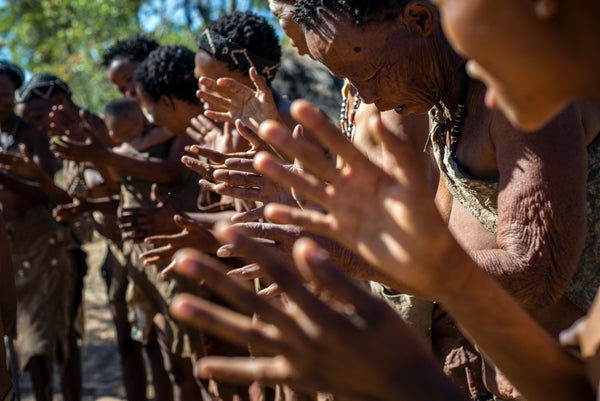
The San people of southern Africa are among the most-studied indigenous groups in the world. Legions of researchers have investigated their hunter-gatherer lifestyles, click languages and ancient rock art, and San individuals were some of the first from Africa to have their whole genomes sequenced.
But some San want a greater say in such research. On March 2, three communities in South Africa issued their own research-ethics code—thought to be the first from any indigenous group in Africa. Although the rules will carry no legal weight, their authors hope that scientists will feel compelled to submit proposals for research in San communities to a review panel of community members. And the San may refuse to collaborate with institutions whose staff do not comply, the rules warn.
The code was developed by traditional leaders of the !Xun, Khwe and !Khomani groups of San, which represent around 8,000 people in South Africa.
On supporting science journalism
If you're enjoying this article, consider supporting our award-winning journalism by subscribing. By purchasing a subscription you are helping to ensure the future of impactful stories about the discoveries and ideas shaping our world today.
“We’ve been bombarded by researchers over the years,” says Hennie Swart, director of the South African San Institute in Kimberley, which helped to develop the code. “It’s not a question of not doing the research. It’s a question of doing it right.”
The impetus for the ethics code was the 2010 publication, inNature, of the first human genome sequences from southern Africa: those of Archbishop Desmond Tutu, winner of the 1984 Nobel Peace Prize, and four San men from Namibia. The Namibian government and ethics committees at the scientists’ universities in Australia, South Africa and the United States approved the study. The researchers also filmed the San men giving verbal consent with the help of a translator.
But some San leaders were upset that the team did not consult them, and were concerned about how the researchers obtained informed consent from the San men, according to Roger Chennells, a human-rights lawyer based in Stellenbosch, South Africa, who helped draft the code (see go.nature.com/2nwyj1m). The study was a “massive catalyst”, he says.
The paper also used terms, including “Bushman”, that some San individuals consider offensive. “No other recent research has been perceived as being so insulting and arrogant to San leaders,” says Chennells.
He anticipates that communities in Namibia and Botswana will formally adopt the code in the future. Until then, researchers working with those communities will be encouraged to take note of the code, adds Chennells.
However, Stephan Schuster, a genome scientist who co-led the study while at Pennsylvania State University in State College, asks whether the views of San leaders in South Africa are representative of other San groups. “Why would a San council in South Africa know what we are doing in northern Namibia?” asks Schuster, who is now at the Nanyang Technological University in Singapore. After the genome paper came out, San leaders held workshops with scientists, ethicists and lawyers to draft research guidelines. The TRUST Project, a European effort to promote global research ethics, funded the drive.
The process for endorsing research under the guidelines is still taking shape, says Swart, but researchers will be encouraged to submit proposals to the South African San Council. The council “undertakes not to unduly curb or hinder good research”, adds Chennells.
Both Chennells and Swart hope that the research code will achieve the same influence as guidelines for working with Aboriginal communities in Australia. There, researchers must typically gain approval from groups that represent local or regional indigenous communities. A 2011 studyreporting the first genome of an Aboriginal Australian (taken from an early-twentieth-century hair sample) was nearly scrapped because the scientists had not initially sought the endorsement of an Aboriginal group. “We are learning from Australians,” says Swart.
“If researchers want to work among the San and that’s the protocol, they should honour it. That’s what social justice is all about,” says Himla Soodyall, a geneticist at the University of the Witwatersrand in Johannesburg, South Africa, who co-authored a 2012 paper analysing the genomes of San individuals.
That team sought permission for its research from the South African San Council and another San organization, the Working Group of Indigenous Minorities in Southern Africa. The researchers communicated their findings to San communities and told individuals what they had learnt about their genetic ancestry.
Emma Kowal, an anthropologist at Deakin University in Melbourne, Australia, who works on indigenous research ethics, thinks the code will encourage scientists to consider the interests of San communities. “Our experience in Australia is that researchers will come to the table and change the way that they practise,” she says.
This article is reproduced with permission and was first published on March 20, 2017.