South Pacific Volcanic Peaks Leave Wakes in the Clouds
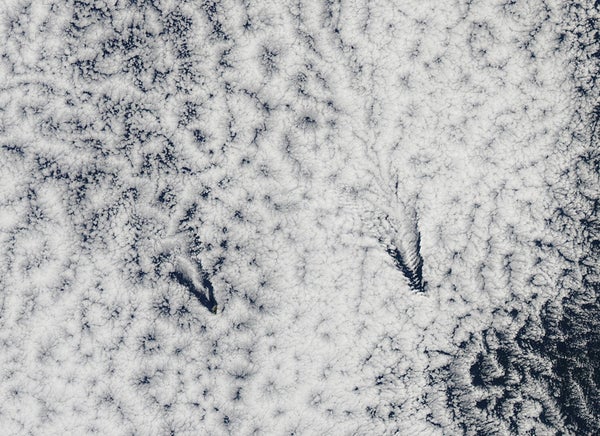
Two Chilean volcanic mountain peaks in the South Pacific left these giant chicken tracks in the clouds in this image captured by NASA's Aqua satellite on April 29.
MODIS Land Rapid Response Team, NASA GSFC, Jeff Schmaltz
Join Our Community of Science Lovers!
On supporting science journalism
If you're enjoying this article, consider supporting our award-winning journalism by subscribing. By purchasing a subscription you are helping to ensure the future of impactful stories about the discoveries and ideas shaping our world today.
Two Chilean volcanic mountain peaks in the South Pacific left these giant chicken tracks in the clouds in this image captured by NASA's Aqua satellite on April 29. Meteorologists call this cloud pattern "ship-wave-shape" because they look like boats' wakes; but in a way they're actually mountains' wakes. When air blows over and around mountain peaks, it rises and falls in ripples with peaks and troughs. Wherever the air rises, it cools and forms clouds. In places where the air falls it warms, dissipating cloud vapors and leaving behind clear spaces.
The ship-wave-shape cloud on the left was induced by the island of Alejandro Selkirk, which has an elevation of 1,330 meters. The one on the right was induced by Robinson Crusoe Island, elevation 915 meters. The islands are so high that they often create atmospheric patterns that can be seen from space, according to NASA.
—Francie Diep
It’s Time to Stand Up for Science
If you enjoyed this article, I’d like to ask for your support. Scientific American has served as an advocate for science and industry for 180 years, and right now may be the most critical moment in that two-century history.
SciAm always educates and delights me, and inspires a sense of awe for our vast, beautiful universe. I hope it does that for you, too.
If you subscribe to Scientific American, you help ensure that our coverage is centered on meaningful research and discovery; that we have the resources to report on the decisions that threaten labs across the U.S.; and that we support both budding and working scientists at a time when the value of science itself too often goes unrecognized.