
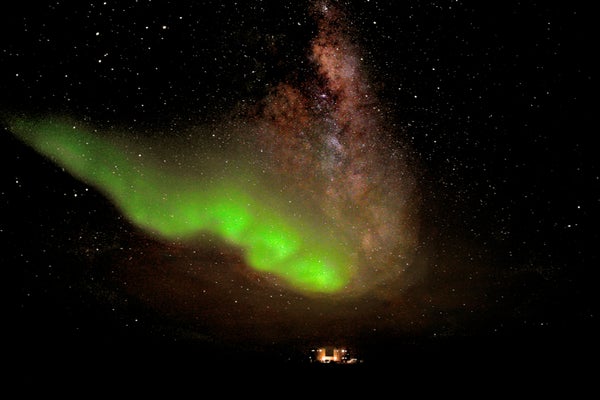
The French–Italian Concordia research station in Antarctica is not your typical location for a medical practice, but working there has its perks. Physician Alexander Kumar and Erick Bondoux, two residents passing austral winter at Concordia, snapped this photo of the dramatic aurorae over the station on July 18.
The outpost is so isolated that no one can come or go for months during the winter, during which time the 13 people there experience complete darkness for more than 100 consecutive days. Add to that an elevation of roughly 3,200 meters, and the conditions at Concordia station are, in a word, harsh.
Enter Kumar, who, as a human spaceflight research M.D. for the European Space Agency, is charged with investigating "how far human physiology and psychology can be pushed towards a future manned mission to Mars," according to his Web site.
On supporting science journalism
If you're enjoying this article, consider supporting our award-winning journalism by subscribing. By purchasing a subscription you are helping to ensure the future of impactful stories about the discoveries and ideas shaping our world today.
In the meantime he and his crew members do get to enjoy the almost otherworldly aurora australis, or southern lights. Aurorae over Earth's poles are the product of charged particles streaming from the sun and colliding with atoms and molecules in the upper atmosphere. At most latitudes the planet's magnetic field repels those particles, but the thinner shielding over the poles allows protons and electrons to penetrate more deeply. The green glow photographed by Kumar and Bondoux emanates from oxygen atoms in the atmosphere returning to their lowest-energy state after being excited by charged solar particles.