
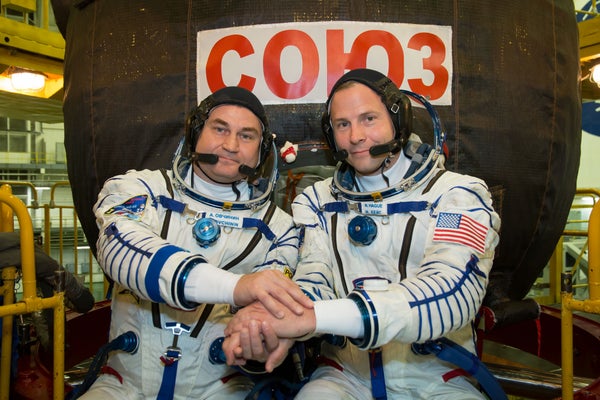
A Russian Soyuz rocket carrying a new U.S.-Russian crew to the International Space Station failed during its ascent Thursday (Oct. 11), sending its crew capsule falling back toward Earth in a ballistic re-entry, NASA officials said.
A search-and-rescue team has reached the landing site, both crewmembers are in good condition and have left the Soyuz capsule as of 6:10 a.m. EDT, NASA spokesperson Brandi Dean said during live television commentary. Russian space agency Roscosmos has released photographs of both astronauts being checked over after their abrupt landing.
The Soyuz rocket and its Soyuz MS-10 space capsule lifted off from the Baikonur Cosmodrome in Kazakhstan at about 4:47 a.m. EDT (0847 GMT) with NASA astronaut Nick Hague and cosmonaut Aleksey Ovchinin aboard. The pair were due to join the three-person Expedition 57 crew already aboard the International Space Station. But something went wrong minutes after liftoff, sending the Soyuz capsule into a ballistic re-entry, NASA officials said.
On supporting science journalism
If you're enjoying this article, consider supporting our award-winning journalism by subscribing. By purchasing a subscription you are helping to ensure the future of impactful stories about the discoveries and ideas shaping our world today.
“Confirming again that the today’s Soyuz MS10 launch did go into a ballistic re-entry mode a little bit after its launch,” Dean said during live television commentary. “That means the crew will not be going to the International Space Station today. Instead they’ll be taking a sharp landing, coming back to Earth.”
The three astronauts currently on board the space station have been informed of the failed launch and their schedule for the day is being reshuffled, since they’ll no longer be able to greet the incoming duo. Mission control told astronauts aboard the space station that during the landing, “the boys” experienced forces of about 6.7 G in a call that NASA later broadcast on the live commentary.
The pair landed about 20 kilometers (12 miles) east of Dzhezkazgan, Kazakhstan. “Search and rescue crews are always pre-staged in the event something like this does happen,” Dean added. Helicopters have already dispatched to look for the Soyuz space capsule, she said.
The crew is returning to Earth in a ballistic descent mode. Teams are working to obtain additional information from our Russian partners. Watch live updates: https://t.co/mzKW5uDsTi pic.twitter.com/kWigYS1gU4
— NASA (@NASA) October 11, 2018
NASA has not provided much detail about the failure, but confirmed in a tweet that there was a problem with booster separation. Dean later confirmed the anomaly during live commentary. During the live broadcast of the launch, narration from Mission Control suggested that the booster failed to separate from the Soyuz capsule.
This is the shimmy that the crew experienced during booster separation - broadcast by NASA, and looped here. So happy they are safe!!
More about the launch failure: https://t.co/Ws3Qu97BWK pic.twitter.com/JH2N3ROMqA
— Steve Spaleta (@stevespaleta) October 11, 2018
NASA has confirmed that Roscosmos has already created a commission to investigate the cause of the anomaly, although it doesn’t expect its counterpart to hold a press conference today. Hague and Ovchinin are being taken from their emergency landing site to Moscow. In a statement, NASA Administrator Jim Bridenstine confirmed he had been informed the two crewmembers were safe.
“NASA Administrator Jim Bridenstine and the NASA team are monitoring the situation carefully,” the statement continued. “NASA is working closely with Roscosmos to ensure the safe return of the crew. Safety of the crew is the utmost priority for NASA. A thorough investigation into the cause of the incident will be conducted.”
The launch failure follows close on the heels of another Soyuz issue, in which a hole was discovered Aug. 29 on the MS-09 spacecraft that delivered the most recent crew to the space station. That 0.08-inch (2-millimeter) hole in the orbital module of the Soyuz vehicle created a small air leak on the space station that was detected by flight controllers on the ground and ultimately repaired by astronauts and cosmonauts on the space station. An investigation into that anomaly and how the hole was formed is also underway.
Had the launch gone smoothly, Ovchinin and Hague would have reached the space station later today. The Soyuz was scheduled to fly a shortened, six-hour flight trajectory that would have orbited the Earth four times before reaching the International Space Station.
Copyright 2018 Space.com, a Future company. All rights reserved. This material may not be published, broadcast, rewritten or redistributed.