
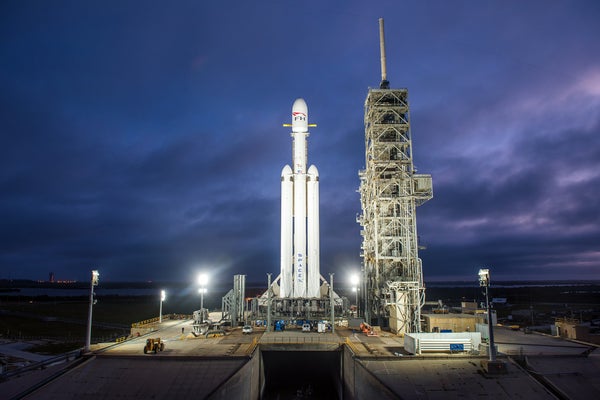
When SpaceX launches its first Falcon Heavy rocket this week, the company is going to attempt something never done before: a rocket-landing triple play.
SpaceX representatives confirmed over the weekend that the Falcon Heavy test flight on Tuesday (Feb. 6) will also include landings for its three first-stage core boosters, which are based on the company's Falcon 9 rocket. Liftoff is scheduled for 1:30 p.m. EST (1830 GMT) from Launch Pad 39A at NASA's Kennedy Space Center in Cape Canaveral, Florida.
"Following booster separation, Falcon Heavy's two side cores will return to land at SpaceX's Landing Zones 1 and 2 (LZ-1 & LZ-2) at Cape Canaveral Air Force Station, Florida," SpaceX representatives said in a statement Saturday (Feb. 3). "Falcon Heavy’s center core will attempt to land on the "Of Course I Still Love You" droneship, which will be stationed in the Atlantic Ocean." [In Photos: SpaceX's 1st Falcon Heavy Rocket at the Pad]
On supporting science journalism
If you're enjoying this article, consider supporting our award-winning journalism by subscribing. By purchasing a subscription you are helping to ensure the future of impactful stories about the discoveries and ideas shaping our world today.
SpaceX has landed Falcon 9 rockets 21 times on land or its robotic drone ships, and has reflown boosters six times, as part of the company's reusable-rocket program. The heavy-lift Falcon Heavy rocket is part of that program, with its three first-stage cores equipped with landing legs and grid-like fins to control their re-entry through Earth's atmosphere.
Residents of central Florida may actually hear the Falcon Heavy boosters during their landing attempt, SpaceX representatives noted.
"There is the possibility that residents of Brevard, Indian River, Orange, Osceola, Seminole, and Volusia counties may hear one or more sonic booms during the landing attempts," SpaceX representatives said. "Residents of Brevard County are most likely to hear one or more sonic booms, although what residents' experience will depend on weather conditions and other factors."
Florida's Space Coast Office of Tourism estimates that up to 100,000 spectators are visiting the area to watch the Falcon Heavy launch, according to a Florida Today report.
SpaceX's Falcon Heavy rocket is billed as the most powerful rocket since NASA's Saturn V moon rocket and can launch payloads of up to 119,000 lbs. (54 metric tons) into space. The rocket can carry twice as much payload as its nearest competitor, United Launch Alliance's Delta IV Heavy booster.
For this first flight, the Falcon Heavy will launch SpaceX CEO Elon Musk's own Tesla Roadster. If all goes well, the midnight-cherry-red electric car will launch on a trajectory that will send it near Mars, Musk has said.
Musk's Roadster looks like it even has a passenger: an apparent mannequin called Starman, which sits in the driver's seat. Musk posted photos of the mannequin on Instagram today (Feb. 5), and we can only assume it will ride along with the Roadster's epic trip.
Musk has said repeatedly that there is a fair chance that this maiden flight of the Falcon Heavy could fail.
"There's a lot that could go wrong there," he said last year. "I encourage people to come down to the Cape to see the first Falcon Heavy mission; it's guaranteed to be exciting."
Visit Space.com for complete coverage of SpaceX's Falcon Heavy test flight this week.
EDITOR'S RECOMMENDATIONS
SpaceX's Huge Falcon Heavy Rocket: How It Works (Infographic)
Falcon Heavy in Pictures: SpaceX's Huge Private Rocket (Gallery)
SpaceX Test-Fires Falcon Heavy Rocket Ahead of Maiden Flight
Copyright 2017 SPACE.com, a Purch company. All rights reserved. This material may not be published, broadcast, rewritten or redistributed.