
The commercial spaceflight company SpaceX announced on Twitter today that it plans to send its robotic Dragon capsule to Mars as early as 2018.
"Red Dragons will inform the overall Mars architecture," SpaceX representatives tweeted today (April 27), referring to the company's eventual plans to set up a colony on Mars — a key goal of SpaceX and its founder, billionaire entrepreneur Elon Musk.
A source familiar with the company’s plans said the first test flight of a Dragon capsule to Mars would demonstrate technologies needed to land large payloads on the Red Planet. That could include supplies and habitats for Martian explorers. In addition, the source said that SpaceX intends to reveal details of its colonization architecture later this year. [SpaceX's Red Dragon: A Private Mars Mission Plan in Pictures]
On supporting science journalism
If you're enjoying this article, consider supporting our award-winning journalism by subscribing. By purchasing a subscription you are helping to ensure the future of impactful stories about the discoveries and ideas shaping our world today.
"Dragon 2 is designed to be able to land anywhere in the solar system. Red Dragon Mars mission is the first test flight," Musk tweeted today. "But wouldn't recommend transporting astronauts beyond Earth-moon region. Wouldn't be fun for longer journeys. Internal volume ~size of SUV."
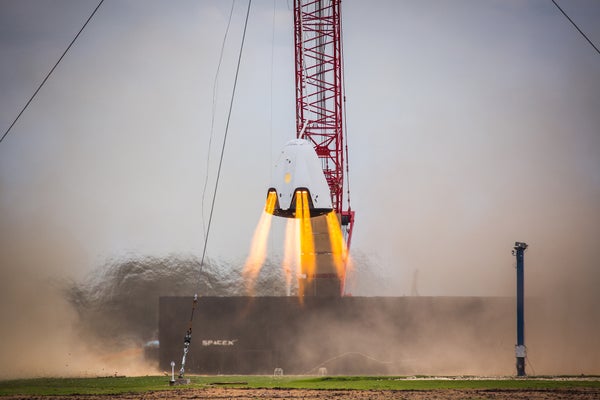
In November 2015, SpaceX released a video showing its Dragon V2 capsule — the crewed version of the spacecraft — during a hover test, meant to demonstrate how the capsule would gently lower itself down onto the surface of a distant world.
Last year, a group of NASA scientists explored the possibility of a Red Dragon mission, in which a SpaceX capsule could be used to pick up the rock and soil samples that will be collected by the agency's Mars 2020 rover, and return them to Earth for further study. That mission has not been approved by NASA, nor has SpaceX confirmed that it would participate.
Recently tested Dragon 2’s SuperDraco propulsive landing system at our McGregor, TX facility. Key for Mars landing pic.twitter.com/dV1nhKDMhr
— SpaceX (@SpaceX) April 27, 2016
In January 2015, during a Reddit "Ask Me Anything" session, Musk said that plans for the company's "Mars Colonial Transporter" — the spaceflight system that will take humans to and from the Red Planet — would be released by the end of the year, but that has not yet happened. The company is currently developing a rocket called the Falcon Heavy, which the company says will have the capacity to carry humans and cargo to deep-space destinations, even Mars.
On April 8, SpaceX passed a major milestone in its development of reusable rockets when it successfully landed the first stage of its Falcon 9 rocket on a drone ship. Musk has said that reusable rockets will dramatically lower the cost of going to space, thereby making ambitious, expensive efforts such as Mars colonization more economically feasible.
SpaceX has a contract with NASA to carry cargo to the International Space Station aboard its Dragon space capsules. Orbital ATK is also a current cargo carrier for the agency. Both companies were selected by NASA for the next round of cargo delivery missions, in addition to the Sierra Nevada Corp.
SpaceX and Boeing were selected to carry astronauts to the orbiting laboratory. NASA has said it wants those crewed flights to begin as early as 2017.
NASA has also announced plans to send humans to Mars as soon as the 2030s, although details of the agency's plan still need to be worked out.
Copyright 2016 SPACE.com, a Purch company. All rights reserved. This material may not be published, broadcast, rewritten or redistributed.