
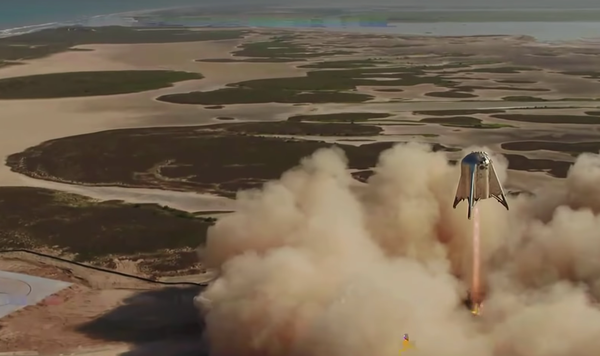
Starhopper’s biggest leap was also its last.
SpaceX’s first prototype for its Mars-colonizing Starship vehicle aced its final test flight today (Aug. 27), rising several hundred feet off the ground at the company’s facility in the tiny South Texas town of Boca Chica.
Starhopper lifted off just after 6 p.m. EDT (2200 GMT; 5 p.m. local Texas time), reached a hover altitude and then flew sideways to touch town at a separate nearby landing pad. The entire flight lasted just 57 seconds.
On supporting science journalism
If you're enjoying this article, consider supporting our award-winning journalism by subscribing. By purchasing a subscription you are helping to ensure the future of impactful stories about the discoveries and ideas shaping our world today.
“Congrats SpaceX team!!” SpaceX CEO Elon Musk wrote on Twitter just after the flight.
The ceiling for today’s flight was 150 meters (about 500 feet), SpaceX founder and CEO Elon Musk said via Twitter this week. That limit was imposed by the U.S. Federal Aviation Administration, which grants licenses for launches and test flights.
So, today’s leap was quite a bit higher than Starhopper’s three previous forays off of terra firma. The first two, conducted in early April, produced barely any separation between the craft and the ground; Starhopper was tethered for safety’s sake both times. The prototype was first unleashed on July 25; the vehicle rose an estimated 65 feet (20 m) into the Texas sky.
Today’s flight was originally scheduled to take place yesterday (Aug. 26). But that attempt was aborted just before liftoff, likely because of an issue with the igniter on Starhopper’s Raptor engine, Musk said. You can watch SpaceX’s full 30-minute webcast replay above.
Starhopper is powered by a single Raptor, the next-generation engine that SpaceX is developing for use on Starship and its giant rocket partner, Super Heavy. The 100-passenger Starship will have six Raptors and the Super Heavy will sport 35, with space for two more on the rocket, Musk has said.
Those numbers could change, however. The billionaire entrepreneur has promised to give a Starship design update soon after Starhopper’s final flight.
Starhopper now hands the test-flight reins to two orbital prototypes, which SpaceX calls Starship Mk1 and Mk2. The company is building Mk1 in Boca Chica and Mk2 on Florida’s Space Coast, reasoning that a little intra-company competition will improve the final Starship design.
Both Mk1 and Mk2 will be powered by at least three Raptors, Musk has said. The test launches of these prototypes will pave the way for operational Starship flights, which could begin as early as 2021.
Those first few commercial liftoffs will probably loft communications satellites. But the first passenger trip could follow shortly thereafter; Japanese billionaire Yusaku Maezawa has booked a Starship flight around the moon, with a target launch date of 2023.
Mars missions will be next, if all goes according to plan. Indeed, that’s SpaceX’s ultimate goal; Musk has repeatedly said that he founded the company back in 2002 primarily to help humanity colonize the Red Planet and become a multiplanet species.
Starhopper’s flying days may be done, but the stubby prototype will be retasked rather than put out to pasture.
“Yes, last flight for Hopper. If all goes well, it will become a vertical test stand for Raptor,” Musk said via Twitter on Saturday.
Copyright 2019 SPACE.com, a Purch company. All rights reserved. This material may not be published, broadcast, rewritten or redistributed.