
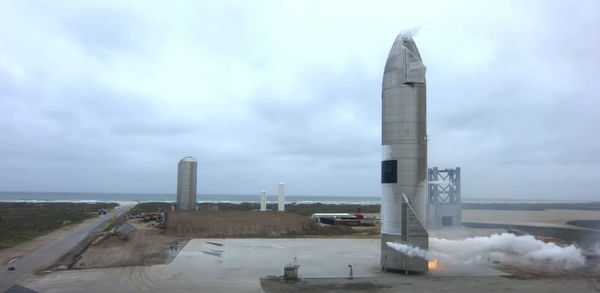
SpaceX’s SN15 stuck the landing.
The private spaceflight company’s latest Starship prototype aced a high-altitude test flight today (May 5), checking every box from takeoff to touchdown for the first time.
“We are down! The Starship has landed,” John Insprucker, SpaceX’s principal integration engineer, said during live commentary.
On supporting science journalism
If you're enjoying this article, consider supporting our award-winning journalism by subscribing. By purchasing a subscription you are helping to ensure the future of impactful stories about the discoveries and ideas shaping our world today.
Today’s uncrewed test came on the 60th anniversary of the United States’ first-ever crewed spaceflight, the suborbital jaunt of NASA astronaut Alan Shepard. The historical parallel is coincidental but appropriate, for SN15’s success marks a big step forward in SpaceX’s plans to help extend humanity’s footprint out into the final frontier.
The stainless-steel SN15 (“Serial No. 15”) lifted off from SpaceX’s Starbase test site, near the South Texas village of Boca Chica, today at 6:24 p.m. EST (2224 GMT). The vehicle soared about 6.2 miles (10 kilometers) into the sky, performed a number of maneuvers and came back down for a safe touchdown at its designated concrete landing pad six minutes after takeoff.
This last bit broke new ground. SN15’s four immediate predecessors all ended up in pieces after attempting similar flights over the past five months, in each case notching pretty much every milestone except “soft landing.”
One of those vehicles, SN10, seemed to touch down safely to wrap up its March flight, but a fire broke out at its base shortly thereafter and the craft exploded. A fire also licked SN15’s base right after today’s landing, but it was extinguished in relatively short order.
SpaceX learned some lessons from those other rough landings. And SN15 is a bit different than those previous prototypes, too.
“SN15 has vehicle improvements across structures, avionics and software, and the engines that will allow more speed and efficiency throughout production and flight: specifically, a new enhanced avionics suite, updated propellant architecture in the aft skirt, and a new Raptor engine design and configuration,” SpaceX representatives wrote in a description of today’s flight.
SpaceX is developing Starship to take people and cargo to the moon, Mars and other distant destinations. The system consists of two elements, both of which are designed to be fully and rapidly reusable: a spacecraft called Starship and a giant first-stage booster named Super Heavy.
Both of these vehicles will be powered by SpaceX’s next-generation Raptor engine. Starship will have six Raptors, and Super Heavy will sport about 30, SpaceX founder and CEO Elon Musk has said.
Though SN15 is a full-scale Starship prototype in terms of height and width, it features just three Raptors. Future test variants will be more powerful, and we should see these brawnier vehicles fly relatively soon; Musk has said that SpaceX aims to launch a Starship into Earth orbit before the end of the year.
If the test program progresses well, Starship could be up and running not long after that. Musk said recently that he expects the system to be fully operational sometime in 2023, though he did acknowledge that his timelines tend to be ambitious.
SpaceX already has a Starship mission on the books with a 2023 target launch date—“dearMoon,” which will send Japanese billionaire Yusaku Maezawa and a handful of other people on a weeklong flight around Earth’s nearest neighbor.
Starship will also fly NASA astronauts to the moon, if all goes according to plan. The space agency’s Artemis program of lunar exploration recently picked Starship as its crewed moon lander.
Artemis aims to establish a sustainable, long-term human presence on and around the moon by the end of the 2020s. The knowledge and skills gained during this effort will help humanity get to Mars in the 2030s, NASA officials have said.
For the past few years, NASA has been working to achieve the first crewed Artemis moon landing by the end of 2024, as directed by the administration of former president Donald Trump. But that timeline is expected to be relaxed under President Joe Biden.
Copyright 2021 Space.com, a Future company. All rights reserved. This material may not be published, broadcast, rewritten or redistributed.