
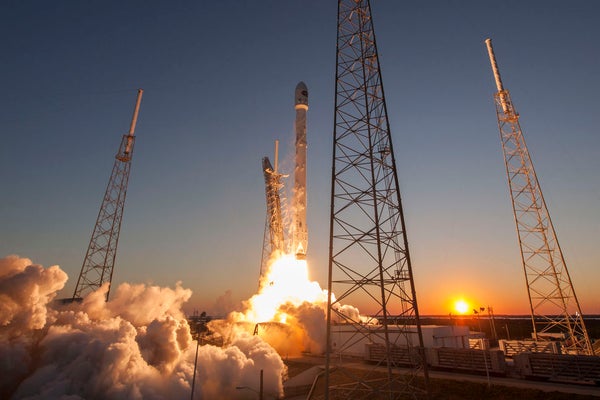
SpaceX is planning to try another epic rocket landing during a satellite launch Sunday (Jan. 17), according to media reports.
The private spaceflight company aims to bring the first stage of its two-stage Falcon 9 rocket back for a soft touchdown on an uncrewed ship in the Pacific Ocean during Sunday's launch of the Jason-3 Earth-observation satellite from Vandenberg Air Force Base in California.
The news was first reported by space journalist Charles Lurio via Twitter, and subsequently confirmed by NBC News.
On supporting science journalism
If you're enjoying this article, consider supporting our award-winning journalism by subscribing. By purchasing a subscription you are helping to ensure the future of impactful stories about the discoveries and ideas shaping our world today.
SpaceX has already pulled off a rocket landing; a Falcon 9 first stage touched down at Florida's Cape Canaveral Air Force Station on Dec. 21 during the launch of 11 spacecraft for satellite-communications company Orbcomm. The milestone marked the first time a booster had ever landed softly during an orbital liftoff. (Blue Origin, a company headed by Amazon.com founder Jeff Bezos, landed its New Shepard rocket during a suborbital test flight this past November.)
SpaceX has attemped a Falcon 9 sea landing twice before, once in January 2015 and again in April of that year. Both times, the rocket stage hit its target but came in too hard, toppling and exploding on the ship's deck.
These touchdown attempts are part of SpaceX's efforts to develop fully and rapidly reusable rockets, technology that company founder and CEO Elon Musk says could cut the cost of spaceflight by a factor of 100. Such dramatic price reductions could, in turn, make Mars colonization economically feasible, Musk has said.
The Jason-3 satellite is designed to measure variations in global sea level extremely precisely, allowing researchers to a get a better understanding of the ongoing effects of climate change. The spacecraft's observations will add to a dataset that has been accruing since the 1992 launch of the TOPEX/Poseidon mission.
The Jason-3 mission is a joint effort involving the U.S. National Oceanic and Atmospheric Administration, the European climate-satellite organization EUMETSAT, the French space agency CNES and NASA.
Originally published on Space.com.
SpaceX's Quest For Rocketry's Holy Grail - Space.com Exclusive Video
SpaceX Falcon 9 First Stage Comes In Hot In Alternate NASA View | Video
Copyright 2016 SPACE.com, a Purch company. All rights reserved. This material may not be published, broadcast, rewritten or redistributed.