SpaceX to Make Starlink Satellites Dimmer to Lessen Impact on Astronomy

Future batches of the satellite will have a special coating to reduce their reflectivity

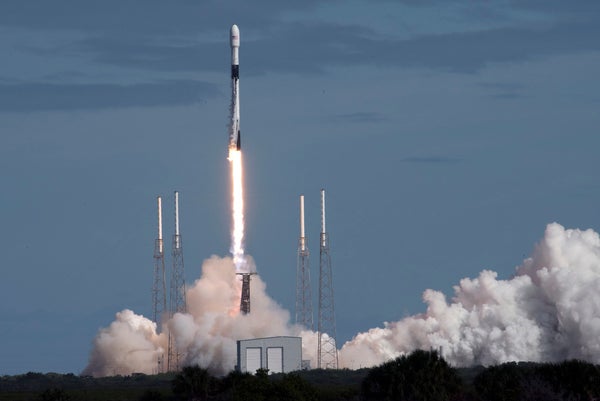
A Falcon 9 rocket launches a batch of Starlink satellites on Nov. 11, 2019.

Join Our Community of Science Lovers!

SpaceX has a fix in play to make its bright Starlink satellites less disruptive to astronomy, according to a SpaceNews report

After the first Starlink internet satellites launched in May, astronomers noticed that the little satellites are quite reflective and bright. With SpaceX reporting it wants to put 42,000 of these satellites in the sky, astronomers were concerned about it washing out parts of the night sky.

So now the company plans to treat one of the Starlink satellites with a special coating, when the next group goes in late December, according to SpaceX president and chief operating officer Gwynne Shotwell. 


On supporting science journalism

If you're enjoying this article, consider supporting our award-winning journalism by subscribing. By purchasing a subscription you are helping to ensure the future of impactful stories about the discoveries and ideas shaping our world today.


Shotwell, in a conversation with SpaceNews and other reporters at SpaceX’s headquarters in Hawthorne, California, said that the company had not anticipated problems with reflective satellites.

“No one thought of this,” Shotwell said, according to SpaceNews. “We didn’t think of it. The astronomy community didn’t think of it.” But once reports came to SpaceX of the bright satellites, she added, the company began looking into fixes for the satellites.”

We want to make sure we do the right thing to make sure little kids can look through their telescope," she said in the SpaceNews report. “Astronomy is one of the few things that gets little kids excited about space.”

SpaceX currently has 120 satellites in its constellation (a second batch of 60 satellites launched in November), and plans to launch more in batches of 60 every two or three weeks in 2020. The constellation should be globally operational around the middle of next year, Shotwell said. 

Copyright 2019 Space.com, a Future company. All rights reserved. This material may not be published, broadcast, rewritten or redistributed.

Elizabeth Howell (she/her), Ph.D., is a staff writer in the spaceflight channel since 2022 covering diversity, education and gaming as well. She was contributing writer for Space.com for 10 years before joining full-time.

More by Elizabeth Howell

SPACE.com is the premier source of space exploration, innovation and astronomy news, chronicling (and celebrating) humanity's ongoing expansion across the final frontier.

More by SPACE.com

It’s Time to Stand Up for Science

If you enjoyed this article, I’d like to ask for your support. Scientific American has served as an advocate for science and industry for 180 years, and right now may be the most critical moment in that two-century history.

I’ve been a Scientific American subscriber since I was 12 years old, and it helped shape the way I look at the world. SciAm always educates and delights me, and inspires a sense of awe for our vast, beautiful universe. I hope it does that for you, too.

If you subscribe to Scientific American, you help ensure that our coverage is centered on meaningful research and discovery; that we have the resources to report on the decisions that threaten labs across the U.S.; and that we support both budding and working scientists at a time when the value of science itself too often goes unrecognized.

In return, you get essential news, captivating podcasts, brilliant infographics, can't-miss newsletters, must-watch videos, challenging games, and the science world's best writing and reporting. You can even gift someone a subscription.

There has never been a more important time for us to stand up and show why science matters. I hope you’ll support us in that mission.

Thank you,

David M. Ewalt, Editor in Chief, Scientific American

Subscribe