
SpaceX ’s first Crew Dragon spaceship to carry astronauts slid into a dock at the International Space Station Sunday (May 31), concluding a historic 19-hour voyage to for its veteran NASA crew.
The arrival marked a major feat: the first docking of a crewed U.S. spacecraft at the station since NASA ’s shuttle fleet retired in 2011. It ’s also the first docking of a commercial spacecraft carrying humans, in this case astronauts Bob Behnken and Doug Hurley.
“It ’s been a real honor to be just a small part of this nine-year year endeavor since the last time United States spaceship has docked with the International Space Station,” said Hurley, commander of the Dragon capsule, as he thanked the SpaceX and NASA teams.
On supporting science journalism
If you're enjoying this article, consider supporting our award-winning journalism by subscribing. By purchasing a subscription you are helping to ensure the future of impactful stories about the discoveries and ideas shaping our world today.
SpaceX launched Behnken and Hurley into space Saturday on a test flight, dubbed Demo-2, that lifted off from NASA ’s Kennedy Space Center in Florida. Their Crew Dragon docked itself at the station 10:16 a.m. EDT (14216 GMT) as both spacecraft sailed 262 miles (422 kilometers) above the border of China and Mongolia.
“Dragon, arriving,” NASA astronaut Chris Cassidy said from inside the station as he range a traditional ship ’s bell. “Bob and Doug, we ’re glad to have you as part of the crew.”
While today ’s docking was completely automated, Hurley did take manual control of the Crew Dragon spacecraft (which he and Behnken have christened Endeavour) during a final test. The ship handled just like the simulator, he said.
“It flew really well. Very crisp,” Hurley said.
After the Crew Dragon docking, Behnken and Hurley performed a series of leak checks to make sure their spacecraft was safely secured to the space station. But at 1:02 p.m. EDT (1702 GMT), the festivities began. That ’s when the crew opened the hatch of their spacecraft to join NASA astronaut Chris Cassidy and Russian cosmonauts Anatoly Ivanishin and Ivan Vagner, who have been in orbit since April .
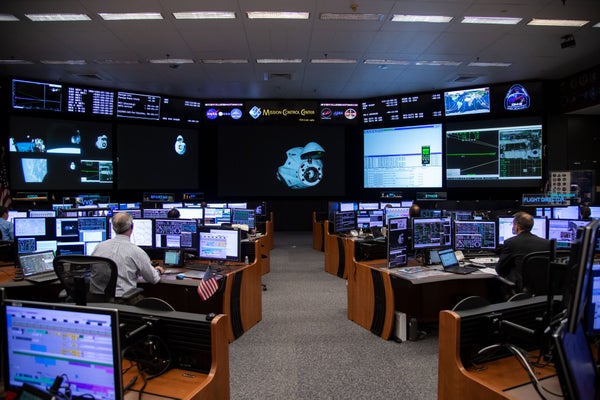
The established residents (the station ’s Expedition 63 crew) help a welcoming ceremony for their new roommates this afternoon, with NASA administrator Jim Bridenstine, Texas Sen. Ted Cruz and other dignitaries calling in congratulations from Mission Control in Houston.
“I will tell you, the whole world saw this mission,” Bridenstine said as he lauded the astronauts.
“It ’s great to get the United States back in the crewed launch business,” Hurley replied. “We ’re just really glad to be on board this magnificent complex.”
The astronauts also got a shout out from SpaceX founder and CEO Elon Musk, whose company built their ride to space.
“Congratulations Bob & Doug on docking & hatch opening on space station!” Musk wrote on Twitter.
Behnken ’s and Hurley ’s arrival brings the inhabitants of the U.S. side of the space station up to three astronauts, and the trio will hold a news conference tomorrow (June 1) at 11:15 a.m. EDT (1515 GMT).
The two new arrivals will spend up to four months living and working on the orbiting laboratory. NASA is seeking to maximize their time in orbit, since astronaut time is a precious commodity, while balancing the fact that Demo-2 is a test mission. SpaceX ’s first full-fledged astronaut mission to the space station, Crew-1 , can ’t blast off until after Demo-2 smoothly returns to Earth.
Right now, the agency is targeting Aug. 30 for that launch , NASA Administrator Jim Bridenstine has said.
Copyright 2020 Space.com, a Future company. All rights reserved. This material may not be published, broadcast, rewritten or redistributed.