New Issue: Orbital Catastrophe Ahead? Read Now

SpaceX’s Starlink Constellation Could Swell by 30,000 More Satellites

The company’s constellation could eventually consist of 42,000 spacecraft

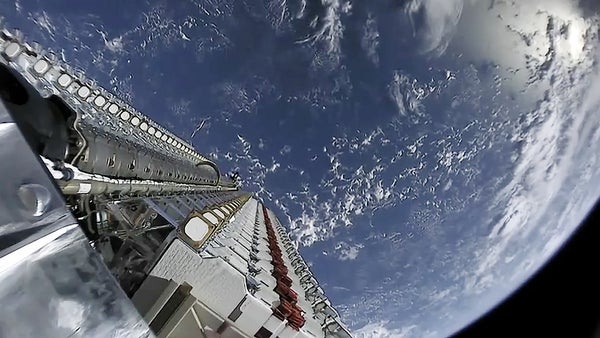
A view of SpaceX's first 60 Starlink satellites in orbit, still in stacked configuration, with the Earth as a brilliant blue backdrop on May 23, 2019.

Join Our Community of Science Lovers!

SpaceX’s Starlink internet-satellite constellation may end up being even bigger than we thought—a lot bigger.

The company already has permission from the U.S. Federal Communications Commission (FCC) to launch up to 12,000 Starlink craft to low Earth orbit. And SpaceX recently filed paperwork with the International Telecommunication Union (ITU) for up to 30,000 additional Starlink satellites, SpaceNews reported yesterday (Oct. 15). 

It’s unclear how many Starlink satellites SpaceX will actually build and launch, however. Submitting to the ITU—a United Nations agency that, among other things, manages the global satellite radio-frequency spectrum—is a preliminary step, as SpaceNews noted. ITU approval would have to be followed by a thumbs-up from the FCC, which regulates interstate communications in the U.S.


On supporting science journalism

If you're enjoying this article, consider supporting our award-winning journalism by subscribing. By purchasing a subscription you are helping to ensure the future of impactful stories about the discoveries and ideas shaping our world today.


And there’s no guarantee SpaceX will end up launching the already-approved 12,000 satellites. Elon Musk, the company’s founder and CEO, said earlier this year that economic viability could come with a constellation of about 1,000 satellites.

But still, launching even a fraction of the potential 42,000 Starlink craft would fundamentally change the orbital population. Just 2,000 operational satellites currently circle our planet, and fewer than 9,000 objects have launched since the dawn of the Space Age, in 1957, according to the U.N. Office for Outer Space Affairs.

The Starlink constellation is already being assembled. In May, SpaceX launched the first 60 satellites in the network, and the company plans to loft the next few batches of 60 soon, likely before the end of the year.

And SpaceX isn’t the only company with megaconstellation ambitions. For example, both Amazon and OneWeb plan to establish big (but not Starlink-big) networks of broadband satellites in low Earth orbit as well.

Copyright 2019 SPACE.com, a Purch company. All rights reserved. This material may not be published, broadcast, rewritten or redistributed.

Mike Wall has been writing for Space.com since 2010. His book about the search for alien life, “Out There,” was published on Nov. 13, 2018. Before becoming a science writer, Michael worked as a herpetologist and wildlife biologist. He has a Ph.D. in evolutionary biology from the University of Sydney, Australia, a bachelor’s degree from the University of Arizona, and a graduate certificate in science writing from the University of California, Santa Cruz.

More by Mike Wall

SPACE.com is the premier source of space exploration, innovation and astronomy news, chronicling (and celebrating) humanity's ongoing expansion across the final frontier.

More by SPACE.com

Subscribe to Support Independent Journalism

Great science journalism requires human expertise, time, effort and creativity. And it costs money. That’s why I and the journalists here at Scientific American hope you’ll join our community.

When you subscribe, you are supporting staff and freelance journalists who are passionate about telling science stories that are true, important and compelling. Our editors and reporters are often experts in their fields, which means they understand the nuances of big discoveries and can untangle the breakthroughs from the hype. With a subscription, you are also supporting rigorous fact-checking to ensure the words we publish are precise and accurate. And you’re supporting original illustrations, graphics and photos that bring you closer to an advanced laboratory, an ice sheet in Antarctica or a space mission in orbit. You’re helping us craft other types of high-quality journalism as well: Our newsletters are carefully written, edited and curated by staffers you have or will come to know and love. Our Science Quickly podcast is based on original reporting, collaboration with editors and scientists and exacting production.

Subscriptions keep this engine running so we can continue to deliver thoughtful, rigorous and independent science journalism to you. In an era of viral misinformation, this work is crucial. If you value what we do, I hope you’ll consider joining us as a subscriber

Thank you,

Jeanna Bryner, Editor in Chief, Scientific American

Subscribe