
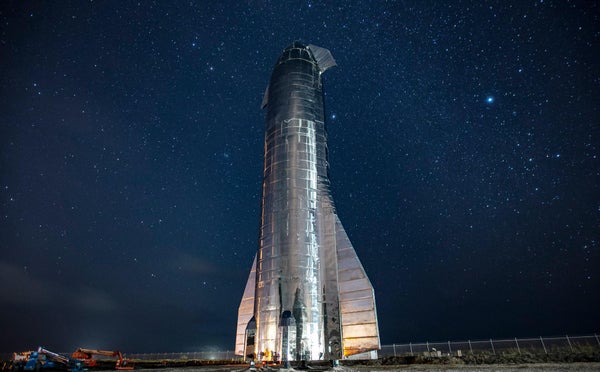
SpaceX just flew a full-size prototype of its
Starship Mars-colonizing spacecraft for the first time ever.
The
On supporting science journalism
If you're enjoying this article, consider supporting our award-winning journalism by subscribing. By purchasing a subscription you are helping to ensure the future of impactful stories about the discoveries and ideas shaping our world today.
Starship SN5 test vehicle took to the skies for about 40 seconds this afternoon (Aug. 4) at SpaceX's facilities near the South Texas village of Boca Chica, performing a small hop that could end up being a big step toward human exploration of the Red Planet.
"Mars is looking real,"
Musk tweeted shortly after today's test flight.
The stainless-steel SN5 rose into the air at 7:57 p.m. EDT (2357 GMT; 6:57 p.m. local Texas time). It traveled sideways a bit during the brief, uncrewed flight, which Musk had previously said would target a maximum altitude of about 500 feet (150 meters). The spacecraft deployed its landing legs as planned and stuck the landing.
The SN5 is just the second Starship prototype to get off the ground, and the first to do so in nearly a year. A squat and stubby vehicle called Starhopper took a few brief flights in the summer of 2019, retiring after
acing its own 500-foot-high hop that August.
Ending this flight lull fell to the SN5 after several of its predecessors were destroyed during pressurization or engine-firing tests.
Starhopper and the SN5 both feature a single
Raptor, SpaceX's powerful next-generation engine. The final Starship vehicle will sport six Raptors, stand about 165 feet (50 m) tall and be capable of carrying up to 100 people, Musk has said.
The operational Starship will launch from Earth atop a gigantic rocket called Super Heavy, which will have 31 Raptors of its own. Both vehicles will be fully and rapidly reusable, potentially slashing the cost of spaceflight enough to make crewed trips to and from the moon, Mars and other deep-space destinations economically feasible, Musk has said.
Super Heavy will land back on Earth after each liftoff; Starship will be powerful enough on its own to get itself off Mars and the moon, both of which have much weaker gravitational pulls than our planet does.
Musk is particularly keen on the Red Planet, stressing repeatedly over the years that he founded SpaceX back in 2002 primarily to help humanity colonize Mars. If all goes well with the development of Starship and Super Heavy, the spaceflight system could enable our species to get a million-person city up and running on the Red Planet in the next 50 to 100 years, the billionaire entrepreneur has said.
A lot of development still needs to get done, of course. SpaceX will iterate repeatedly before arriving at the final Starship design, which will then need to be tested. And then there's Super Heavy, no version of which has yet been built, let alone gotten off the ground.
But if all goes well, we could see Starship and Super Heavy flying together soon, on exciting and important missions. The SpaceX system is a
contender to land NASA astronauts on the moon in the mid-2020s and beyond, for example. And Japanese billionaire Yusaku Maezawa has booked a crewed Starship trip around the moon, with a targeted launch date of 2023.
In the much nearer term, however — the coming days and weeks — we should expect a few more short test hops like the one we saw today.
"We’ll do several short hops to smooth out launch process, then go high altitude with body flaps," Musk said in another tweet today. ("High altitude" could be around 12 miles, or 20 kilometers, up, if previous Musk tweets are any guide.)
Today's Starship milestone comes just two days after another big moment for SpaceX. On Sunday (Aug. 2), the company's
Crew Dragon capsule splashed down in the Gulf of Mexico off the Florida coast, bringing an end to Demo-2, SpaceX's first crewed mission. Demo-2, a key test flight for the system, sent NASA astronauts Bob Behnken and Doug Hurley to the International Space Station for two months.
Copyright 2020 Space.com, a Future company. All rights reserved. This material may not be published, broadcast, rewritten or redistributed.