
SpaceX’s Starship spaceflight system just took a big step on its path to Mars.
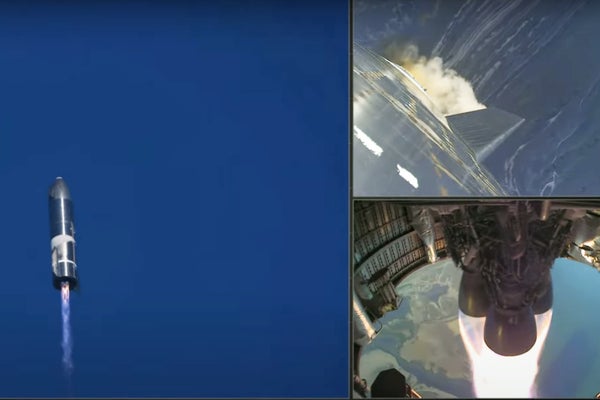
The latest Starship prototype, a shiny silver vehicle known as SN8, launched on an epic high-altitude test flight today (Dec. 9), taking off at 5:45 p.m. EST (2245 GMT) from SpaceX’s facility near the South Texas village of Boca Chica.
The goal was to soar about 7.8 miles (12.5 kilometers) into the sky, perform some complex aerial maneuvers—including a “belly flop” like the one the final Starship will perform when coming back to Earth on operational flights—and then land safely near the launch stand.
On supporting science journalism
If you're enjoying this article, consider supporting our award-winning journalism by subscribing. By purchasing a subscription you are helping to ensure the future of impactful stories about the discoveries and ideas shaping our world today.
The 165-foot-tall (50 meters) SN8 appeared to notch all of these big milestones, except for the final one: The vehicle hit its landing mark but came in too fast, exploding in a dramatic fireball 6 minutes and 42 seconds after liftoff.
SN8’s rapid unplanned disassembly did nothing to dampen the spirits of SpaceX founder and CEO Elon Musk, who was thrilled by the results of today’s flight.
“Fuel header tank pressure was low during landing burn, causing touchdown velocity to be high & RUD, but we got all the data we needed! Congrats SpaceX team hell yeah!!” Musk tweeted this evening.
“Mars, here we come!” he added in another tweet.
Musk was not expecting complete, wire-to-wire success today; he had previously given SN8 (short for “Serial No. 8”) just a 1-in-3 chance of landing in one piece.
That’s because today’s flight was far more complex and demanding than any other Starship prototype test. The previous altitude record was about 500 feet (150 m), achieved by three different Starship vehicles—the stubby Starhopper, SN5 and SN6.
All three of those predecessors were pretty bare-bones; they looked like flying silos and featured just one of SpaceX’s next-generation Raptor engines. SN8 was much more capable and complex. It was powered by three Raptors and had a nose cone and stabilizing body flaps.
These new pieces did their jobs well today, Musk said in another tweet: “Successful ascent, switchover to header tanks & precise flap control to landing point!”
SpaceX is developing Starship to carry people and cargo to the moon, Mars and other distant destinations. The system consists of two elements: a stainless-steel spacecraft called Starship, which will sport six Raptors, and a giant rocket known as Super Heavy, which will have about 30 of the engines.
Both of these vehicles will be fully and rapidly reusable, Musk has said. Starship will be capable of making many trips from Earth to Mars and back, and each Super Heavy will rack up many launches during its life. (Starship will be powerful enough to launch itself off the moon and Mars, but it will need Super Heavy to get off our much more massive Earth.)
SpaceX wants Starship and Super Heavy to be operational soon. NASA’s Artemis program is considering using Starship to land astronauts on the lunar surface, for example, and the first of those touchdowns is targeted for 2024. And Musk recently said he’s confident that SpaceX will launch its first crewed Mars mission by 2026, with the milestone possible in 2024 “if we’re lucky.”
SpaceX aims to meet this ambitious timeline by iterating fast and flying often. The company is building multiple Starship prototypes at its South Texas site, and we should expect those coming vehicles to get off the ground fairly soon—especially SN9, which is apparently nearly done.
SN9 and SN10 will be quite similar to the three-engine SN8, featuring “many small improvements” over the vehicle that flew today, Musk said via Twitter on Nov. 24. “Major upgrades are slated for SN15," he said in another tweet that day.
Today’s launch was originally scheduled to take place yesterday (Dec. 8). But SN8 detected something abnormal with one or more of its Raptors and aborted the attempt automatically less than two seconds before liftoff.
Copyright 2020 Space.com, a Future company. All rights reserved. This material may not be published, broadcast, rewritten or redistributed.