
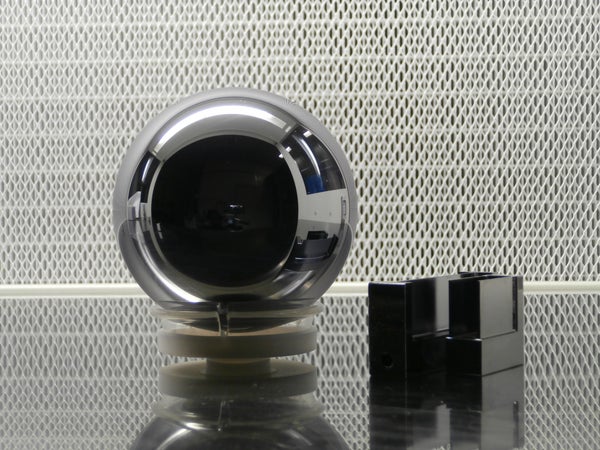
The perfect sphere that will be used to redefine the kilogram in terms of the Planck constant in 2018 has been shown to consist of the purest silicon ever made.
The kilogram is the only unit still based on a physical object. The ‘big k’ is a platinum–iridium cylinder stored in an underground vault in France. However, over time this artefact can gain or lose atoms, which is why the International Committee for Weights and Measures decided to redefine the unit using the Planck constant. This fundamental physical constant relates to mass through Einstein’s formula E = mc2.
One way to calculate Planck’s constant involves determining Avogadro’s constant, the number of particles in a given amount of a substance. To do this, scientists will calculate the atoms in a silicon sphere—but this only works if the crystal is free of impurities.
On supporting science journalism
If you're enjoying this article, consider supporting our award-winning journalism by subscribing. By purchasing a subscription you are helping to ensure the future of impactful stories about the discoveries and ideas shaping our world today.
Researchers at the National Institute for Metrology Research, Italy, and the Australian Nuclear Science and Technology Organisation checked a sample of the sphere for 65 elemental impurities using neutron activation analysis. This bombards the sample with neutrons, which causes atoms to form radioactive isotopes. As each element has a particular decay path, neutron activation analysis can determine the nature and amount of each element within the sample.
The ‘largest’ impurity the team found was copper—approximately 70 nanograms per gram of sample. This adds up to about one copper atom for every three billion silicon atoms. Other elements were found in even tinier amounts—picograms to femtograms per gram of silicon—including chromium, cobalt, gallium, arsenic, bromine, lanthanum, tungsten and gold. The researchers found no traces of any of the other elements, down to their detection limits.
With all the impurities accounted for, 1kg of the material would weigh 0.7μg less than it should if every atom were silicon. This makes the sphere, which is highly enriched in the element’s most abundant isotope silicon-28, even purer than a previously made orb used for the latest determination of the Avogadro constant.
This article is reproduced with permission from Chemistry World. The article was first published on June 18, 2017.