
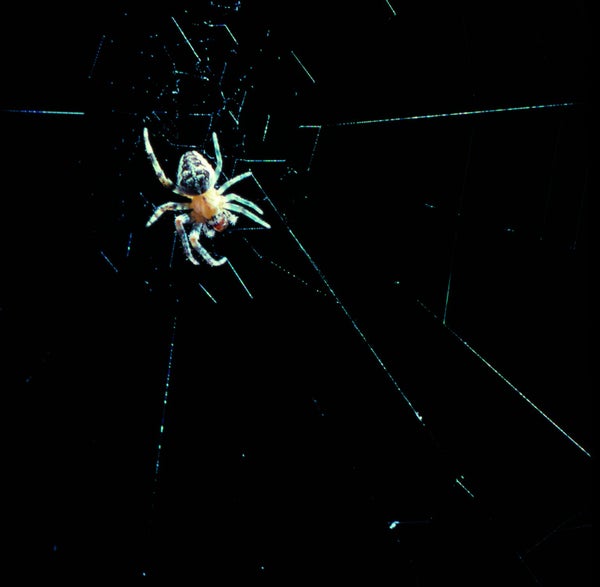
Spider legs seem to have minds of their own. According to findings published in the Journal of the Royal Society Interface, each leg functions as a semi-independent “computer,” with sensors that read the immediate environment and trigger movements accordingly. This autonomy helps the arachnids quickly spin perfect webs with minimal brain use. The study authors simulated surprisingly simple rules to govern this complex behavior—which could eventually be applied to robotics.
“The novelty of this paper is really to lay out an interesting and potentially very important paradigm to study and test new ideas about the next generation of robots,” says University of Oxford biologist Fritz Vollrath, lead author of the paper. “The spider's web-building behavior is a perfect example to study these kinds of questions in detail.”
The study revolves around “morphological computation,” the idea of a function being encoded in a body part instead of relying on the brain for instructions. Examples include the human knee-jerk reflex and the act of walking. “Basically there's a shortcut, and the brain doesn't even know what's happening down there,” Vollrath says. This outsourcing spares the brain from overseeing standard actions honed by evolution or practice.
On supporting science journalism
If you're enjoying this article, consider supporting our award-winning journalism by subscribing. By purchasing a subscription you are helping to ensure the future of impactful stories about the discoveries and ideas shaping our world today.
Roboticists are intrigued by morphological computation for the same reason: it saves computing power and time. But few studies have deeply examined the phenomenon in nature. Spiders, Vollrath says, were ideal for an experiment to fill in this gap—not only because it is easy to spot design changes in their geometric webs but also because molting spiders regenerate broken-off legs.
Vollrath and his co-author, Thiemo Krink, then a computer scientist at Aarhus University, filmed and digitized the movements of several cross spiders, each with partially regenerated, half-length legs at certain positions. These spiders built webs as quickly and perfectly as those with eight full-length legs; if the brain were computing how to compensate for shorter legs, the researchers say, they would have seen tiny but measurable delays in operation. Instead the study suggests a spider's leg receives basic brain commands but adjusts its movements based on local input from sensors, which include hairs and slits in the body covering.
By comparing shorter and longer legs' actions, the researchers also inferred underlying rules for how the legs automatically move to measure angles and lengths when building webs. They tested the rules by programming a simulated virtual spider, and Vollrath says the next step is to build a physical spider robot.
“I find this work extremely interesting, telling us more about spiders and also about morphological computation,” says Cecilia Laschi, a bioroboticist now at the National University of Singapore, who was not involved in the study.* “You never know what remarkable innovations basic science like this could bring.”
*Editor’s Note (1/15/21): This sentence was edited after posting to update Cecilia Laschi’s affiliation.