
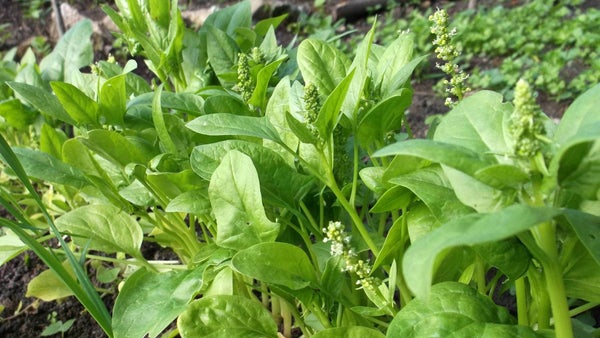
Scientists in the US have made a bionic spinach plant that soaks up explosive molecules from groundwater and gives off an infrared signal.
Removing contaminants from soil is a time consuming and costly endeavour. But growing plants in affected areas offers a cheap and sustainable way of dealing with waste. Known as phytoremediation, the field exploits a plant’s ability to absorb and concentrate nutrients in their leaves or stem. Once the waste is absorbed, the plant can simply be pulled out of the soil.
This property also makes plants ideal for detecting contaminants, according to Min Hao Wong from the Massachusetts Institute of Technology. ‘Through the transpiration process, plants draw up water and other analytes from the ground, and can accumulate even trace levels of analytes within [their] tissues,’ he says.
On supporting science journalism
If you're enjoying this article, consider supporting our award-winning journalism by subscribing. By purchasing a subscription you are helping to ensure the future of impactful stories about the discoveries and ideas shaping our world today.
To exploit this potential, Wong and his colleagues made a nanobionic plant that can both detect explosives in groundwater and alert a user to their presence in the area. The team first injected IR-fluorescent carbon nanotubes (CNTs) into a spinach plant’s leaves. Once treated, the spinach’s roots were wrapped in cheesecloth and the common explosives component picric acid (2,4,6-trinitrophenol) was pipetted onto them.
‘We first designed carbon nanotube based sensors that selectively respond to nitroaromatics,’ explains Wong. ‘These nanotubes quench in fluorescence intensity in the presence of nitroaromatics—we also designed a reference sensor that is invariant in signal intensity.’
The plant draws the nitroaromatics up through the roots into its leaves, where the suppressed IR signal is imaged with a night-vision camera and sent to a smartphone via a WiFi signal. With the reference sensor embedded in the leaf as well, the technique produces high contrast images.
This simple nanobionic system will offer ‘easy adoption in the field’, according to Wong. ‘There are complex environmental and technological issues to explore,’ he says. ‘But we are confident that plant nanobionics is here to stay.’
Wong’s group is so confident in the plant’s potential they have set up a company called Plantea to explore how the technology can plant its roots in industry.
‘This is an excellent example of nanoengineering,’ comments Martin Pumera, a nanobiosystems specialist from Nanyang Technological University in China. ‘These explosives-sensing plants are of very high importance for environmental remediation.’
This article is reproduced with permission from Chemistry World. The article was first published on November 2, 2016.