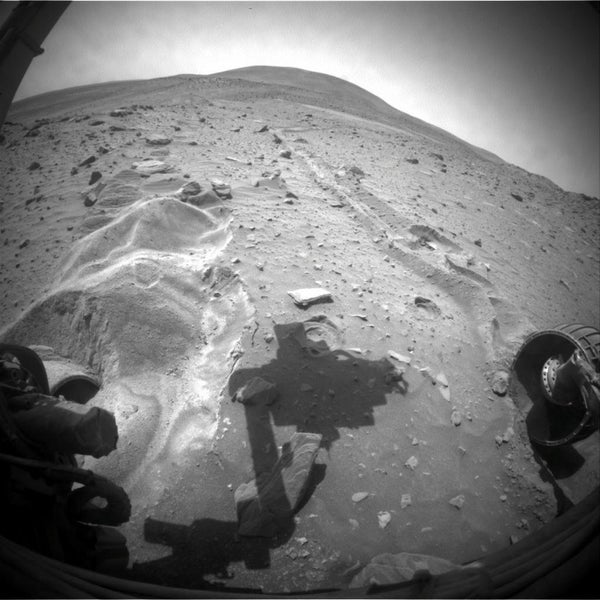
Spirit rover budges forward, but not by much

Engineers at the Jet Propulsion Laboratory in Pasadena, Calif., have been working to free NASA's Spirit rover from a soft patch of Mars soil for more than two weeks now , but progress in the struggle has been hard to come by.

NASA/JPL-Caltech

Join Our Community of Science Lovers!


On supporting science journalism

If you're enjoying this article, consider supporting our award-winning journalism by subscribing. By purchasing a subscription you are helping to ensure the future of impactful stories about the discoveries and ideas shaping our world today.


Engineers at the Jet Propulsion Laboratory in Pasadena, Calif., have been working to free NASA's Spirit rover from a soft patch of Mars soil for more than two weeks now, but progress in the struggle has been hard to come by. After a series of attempted extraction moves, Spirit has budged, but not by much. By the end of a drive on November 28, which ended prematurely when one of the rover's wheels stalled, Spirit had spun its wheels a linear distance of 9.5 meters but had moved forward only 16 millimeters. (It had also sunk five millimeters downward.)

The robotic explorer became embedded in soft soil more than seven months ago, and its operators carefully weighed escape options before commencing drive attempts on November 17. The plan is to move Spirit forward, retracing its path so as to avoid breaking new ground. (The rover had been driving backward for years because of a front wheel failure.)

Mission managers have cautioned that Spirit may never extricate itself from Troy, as the troublesome area of Mars has become known. But the rover, along with its more mobile twin Opportunity, has long outlived its original assignment. Tapped for three-month missions on the Red Planet, both Spirit and Opportunity will mark their six-year anniversaries of reaching Mars early next year.

It’s Time to Stand Up for Science

If you enjoyed this article, I’d like to ask for your support. Scientific American has served as an advocate for science and industry for 180 years, and right now may be the most critical moment in that two-century history.

I’ve been a Scientific American subscriber since I was 12 years old, and it helped shape the way I look at the world. SciAm always educates and delights me, and inspires a sense of awe for our vast, beautiful universe. I hope it does that for you, too.

If you subscribe to Scientific American, you help ensure that our coverage is centered on meaningful research and discovery; that we have the resources to report on the decisions that threaten labs across the U.S.; and that we support both budding and working scientists at a time when the value of science itself too often goes unrecognized.

In return, you get essential news, captivating podcasts, brilliant infographics, can't-miss newsletters, must-watch videos, challenging games, and the science world's best writing and reporting. You can even gift someone a subscription.

There has never been a more important time for us to stand up and show why science matters. I hope you’ll support us in that mission.

Thank you,

David M. Ewalt, Editor in Chief, Scientific American

Subscribe