
On supporting science journalism
If you're enjoying this article, consider supporting our award-winning journalism by subscribing. By purchasing a subscription you are helping to ensure the future of impactful stories about the discoveries and ideas shaping our world today.
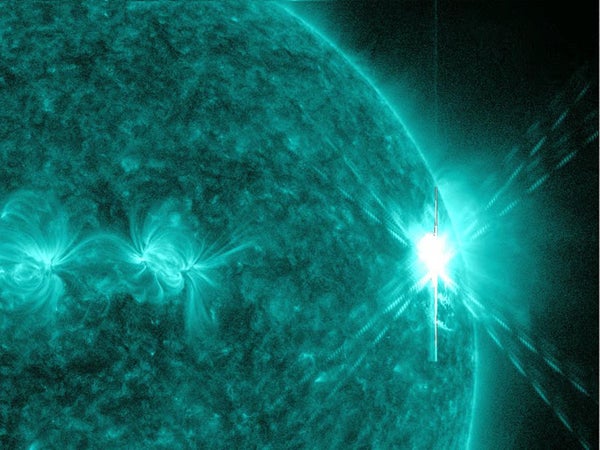
In the early morning hours of August 9, a huge solar explosion shot particles of light and energy out into space. This flare, captured above in ultraviolet light, was strong enough to potentially interfere with radio communication and GPS signals, and there were somereports of temporary disruptions on Tuesday. Although the substantial radiation released could harm unprotected humans in space, it cannot penetrate Earth's atmosphere to cause such harm on the ground. (If necessary, astronauts in the International Space Station can shelter in the station's shielded areas.)
The sun's energy levels vary cyclically over 11-year periods, and astronomers predict that the current cycle's solar maximum is fast-approaching. The National Oceanic and Atmospheric Administration's GOES satellite classified the Tuesday explosion as an X-class solar flare, the largest on a Richter-type scale where each level represents a 10-fold increase in power.
X-class flares, associated with sunspots, are generated when a buildup of energy in the sun's magnetic field suddenly is released. They create fiery outshoots of gas that, according to NASA, "can produce as much energy as a billion hydrogen bombs."
The August 9 flare, recorded [below] by NASA's Solar Dynamics Observatory (SDO), clocked in at X6.9.
—Lauren F. Friedman