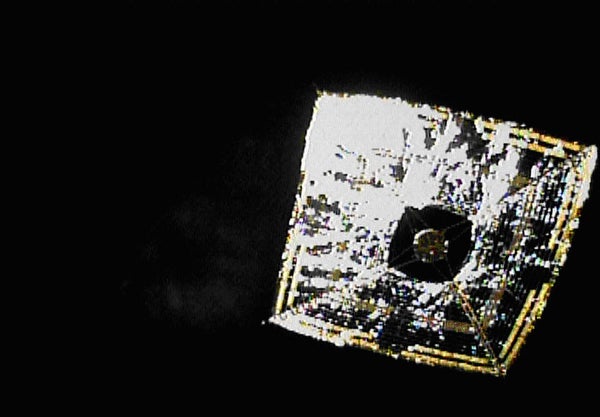
Spring-loaded camera photographs IKAROS's deployed solar sail
The Japanese space agency's attempt to sail a spacecraft between the planets in our solar system, pushed along by sunlight, is off to a good start.
On supporting science journalism
If you're enjoying this article, consider supporting our award-winning journalism by subscribing. By purchasing a subscription you are helping to ensure the future of impactful stories about the discoveries and ideas shaping our world today.
The Japanese space agency's attempt to sail a spacecraft between the planets in our solar system, pushed along by sunlight, is off to a good start. The Interplanetary Kite-craft Accelerated by Radiation of the Sun (IKAROS), launched in May piggybacking on a Venus-bound space probe, successfully deployed its rectangular sail designed to harness the gentle but constant pressure exerted by photons striking the craft, the Japan Aerospace Exploration Agency (JAXA) announced June 11.
With the help of a detachable camera, JAXA has now photographed the deployed 14- by 14-meter solar sail in its entirety. On June 15, IKAROS released the spring-loaded camera module, a cylinder about six centimeters in diameter, which snapped a series of pictures of the larger craft as it drifted away. In a statement JAXA said it would continue to monitor IKAROS to verify that sunlight is indeed accelerating the craft. If the sail concept proves out, IKAROS could approach Venus in several months, becoming the first mission that achieves propulsion via a solar sail to cruise beyond Earth orbit.
Subscribe to Support Independent Journalism
Great science journalism requires human expertise, time, effort and creativity. And it costs money. That’s why I and the journalists here at Scientific American hope you’ll join our community.
When you subscribe, you are supporting staff and freelance journalists who are passionate about telling science stories that are true, important and compelling. Our editors and reporters are often experts in their fields, which means they understand the nuances of big discoveries and can untangle the breakthroughs from the hype. With a subscription, you are also supporting rigorous fact-checking to ensure the words we publish are precise and accurate. And you’re supporting original illustrations, graphics and photos that bring you closer to an advanced laboratory, an ice sheet in Antarctica or a space mission in orbit. You’re helping us craft other types of high-quality journalism as well: Our newsletters are carefully written, edited and curated by staffers you have or will come to know and love. Our Science Quickly podcast is based on original reporting, collaboration with editors and scientists and exacting production.
Subscriptions keep this engine running so we can continue to deliver thoughtful, rigorous and independent science journalism to you. In an era of viral misinformation, this work is crucial. If you value what we do, I hope you’ll consider joining us as a subscriber