
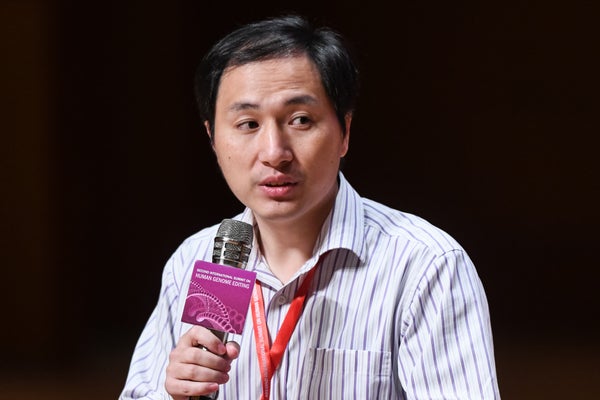
Stanford University cleared three faculty members of any misconduct in their interactions with the Chinese scientist who created “CRISPR babies” last year, the school announced on Tuesday evening. A review by a faculty member and an outside investigator concluded that they “were not participants in [He Jiankui’s] research regarding genome editing of human embryos for intended implantation and birth and that they had no research, financial or organizational ties to this research.”
The scientists whose conduct had been questioned were bioethicist Dr. William Hurlbut, who had had extensive conversations with He but who said He did not tell him he intended to create pregnancies with gene-edited IVF embryos; biologist Matthew Porteus, whom He did inform of his intentions and who said he advised He not to go ahead; and bioengineer Stephen Quake, whom He also informed and who urged He to seek all required ethical approvals in China before proceeding. Quake was He’s postdoctoral adviser in 2011 and 2012.
“The review found that the Stanford researchers expressed serious concerns to Dr. He about his work,” the university said in a statement. “When Dr. He did not heed their recommendations and proceeded, Stanford researchers urged him to follow proper scientific practices, which included identifying an unmet medical need, securing informed consent, obtaining Institutional Review Board (IRB) approval and publishing the research in a peer-reviewed journal.”
On supporting science journalism
If you're enjoying this article, consider supporting our award-winning journalism by subscribing. By purchasing a subscription you are helping to ensure the future of impactful stories about the discoveries and ideas shaping our world today.
He, a researcher at Southern University of Science and Technology in Shenzhen, used the genome-editing technology CRISPR in single-cell IVF embryos. His intention was to alter a gene called CCR5 into a form that prevents HIV from entering cells, which he justified by saying the edit would protect against AIDS. The university fired him, and in January a government investigation concludedhe had defied government bans on embryo editing in the pursuit of personal fame.
Porteus and other scientists whom He informed about his plan have said that although they strongly disapproved of embryo editing—which they viewed as not ready to be used in humans and for a purpose (preventing HIV infection) that does not constitute a serious unmet medical need—they did not know how to inform authorities of He’s intention. In the wake of He’s announcement last November, the World Health Organization and other scientific groups are trying to develop a registry where scientists conducting human genome editing studies would voluntarily report their work, and through which scientists could raise concerns about the work of other researchers.
“I don’t think they did anything wrong but I do wish each had done something more but more that science had established a framework to encourage them to do so,” Stanford law professor and bioethicist Hank Greely tweeted in response to the university statement.
Meanwhile, Rice University has still not announced any results from its investigation into bioengineer Michael Deem, who reportedly worked on the research with He. Deem told the Associated Press that he was there when participants in He’s research gave their consent, though his lawyers later claimed that Deem “did not do human research on this project.”
Andrew Joseph contributed reporting.
Republished with permission from STAT. This article originally appeared on April 17, 2019