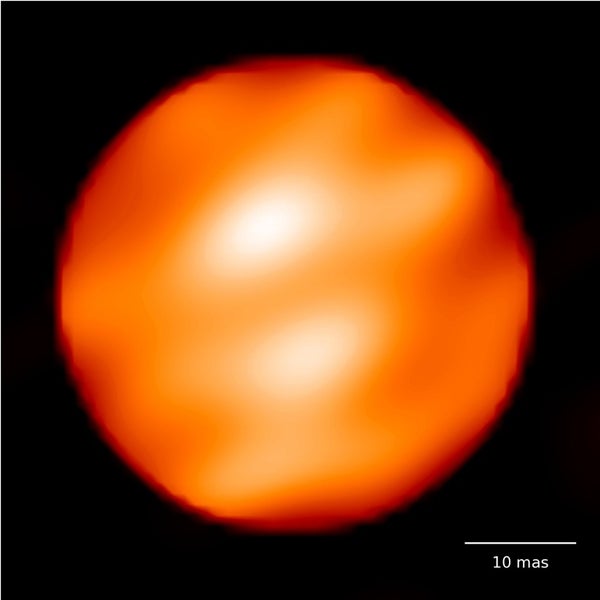
Star-spots on Betelgeuse

Betelgeuse, in the constellation Orion, is one of the brightest stars in the night sky and is the second-largest star in apparent size from our vantage point (not counting the sun, that is).

©2010 Haubois / Perrin (LESIA, Observatoire de Paris)

Join Our Community of Science Lovers!


On supporting science journalism

If you're enjoying this article, consider supporting our award-winning journalism by subscribing. By purchasing a subscription you are helping to ensure the future of impactful stories about the discoveries and ideas shaping our world today.


Betelgeuse, in the constellation Orion, is one of the brightest stars in the night sky and is the second-largest star in apparent size from our vantage point (not counting the sun, that is). Those attributes are made all the more impressive by the fact that Betelgeuse is some 650 light-years away—nowhere near cracking the list of the closest stars to our solar system.

Its brightness and size arise from the fact that the star is a red supergiant, a stage late in the life cycle of some stars in which they swell to great size. Estimates of Betelgeuse's physical size vary, but it is at least several hundred times the diameter of the sun.

Using observation data taken in 2005 at the now-defunct Infrared Optical Telescope Array in Arizona, Xavier Haubois and Guy Perrin of the Paris Observatory and their colleagues reconstructed an infrared image of the massive star. The researchers published their findings in December 2009 in Astronomy & Astrophysics. The highly detailed portrait revealed two bright spots on Betelgeuse of the kind that have long been known to swirl across the surface, two or three at a time. These spots could be markers of convection within the red supergiant, the authors report, and may trace the influence of Betelgeuse's magnetic field on its surface in much the same way that sunspots do on the sun.

It’s Time to Stand Up for Science

If you enjoyed this article, I’d like to ask for your support. Scientific American has served as an advocate for science and industry for 180 years, and right now may be the most critical moment in that two-century history.

I’ve been a Scientific American subscriber since I was 12 years old, and it helped shape the way I look at the world. SciAm always educates and delights me, and inspires a sense of awe for our vast, beautiful universe. I hope it does that for you, too.

If you subscribe to Scientific American, you help ensure that our coverage is centered on meaningful research and discovery; that we have the resources to report on the decisions that threaten labs across the U.S.; and that we support both budding and working scientists at a time when the value of science itself too often goes unrecognized.

In return, you get essential news, captivating podcasts, brilliant infographics, can't-miss newsletters, must-watch videos, challenging games, and the science world's best writing and reporting. You can even gift someone a subscription.

There has never been a more important time for us to stand up and show why science matters. I hope you’ll support us in that mission.

Thank you,

David M. Ewalt, Editor in Chief, Scientific American

Subscribe