
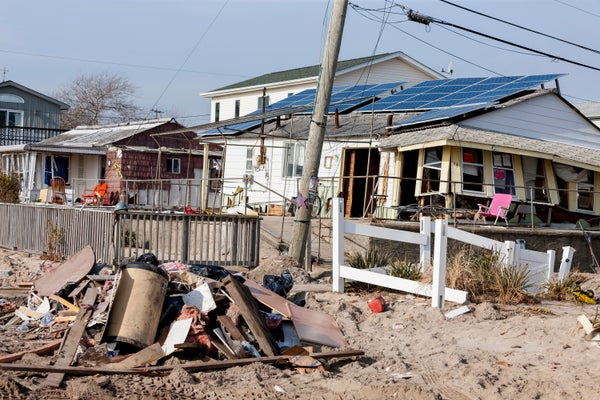
Property owners on the front lines of climate disasters often stay put for reasons that have little to do with risk but everything to do with quality of life, familial bonds and shared history, experts told a major adaptation conference being hosted this week by Columbia University.
"People say, 'The birds. We love the birds.' They say they love the water, or that's where their family is and where their history is," Thaddeus Pawlowski, director of Columbia's Center for Resilient Cities and Landscapes, told participants during a session probing why people choose to live in high-risk places.
Those questions are particularly relevant for communities with deep connections to coastal zones, floodways or wildfire-prone areas, as well as for people who lack the financial means, tools or opportunities to move to safer ground.
On supporting science journalism
If you're enjoying this article, consider supporting our award-winning journalism by subscribing. By purchasing a subscription you are helping to ensure the future of impactful stories about the discoveries and ideas shaping our world today.
Such communities — from the Red Hook neighborhood in Brooklyn, N.Y., to Pinhook, Mo., in the Mississippi River floodplain — are under increasing pressure to choose whether to stay or go, experts said.
Questions about what experts call "managed retreat" transcend geography, culture, race and socioeconomic status; in some cases, wealthy shoreline communities face very high climate risks and choose to stay. But it's unequivocally true that low-income people, communities of color and Indigenous peoples often face untenable decisions when faced with "managed retreat."
Beyond the prospects of safer living conditions, managed retreat also raises questions about self-determination, equity and social justice.
"Some of the critical questions we have to keep in mind ... is: Who is pulling the strings around development in general, even in the context of managed retreat? Who is managing, and who is being managed?" said Jacqueline Patterson, senior director of the NAACP's environmental and climate justice program.
In many instances, she said, decisionmaking is skewed toward whiter, more affluent people who lack knowledge, empathy and even relationships with communities that are feeling the greatest impacts from climate change.
"Even as we talk about solutions, climate action planning often results in displacement if not done right," Patterson said.
A.R. Siders, an assistant professor of public policy at the University of Delaware and core faculty member at the university's Disaster Research Center, said that among the hurdles facing experts and elected officials is overcoming assumptions about adaptation, including that sea walls, levees and other landscape alterations are the best way to protect communities from disasters.
"Even today, there are debates as to whether [managed retreat] is adaptation or a failure to adapt," Siders said. Even so, decisions over whether to stay or go will become more pressing as seas rise, storms grow more severe, and more properties face damage or destruction from climate change impacts.
"We're gaining insights into adaptation of all kinds, into environmental justice and social justice, and [patterns of] development and governance," she said. "We're also understanding how our governance strategies are failing parts of our communities. We're learning about loss and heritage ... and about what it means for adaptation to be fair or just."
The virtual conference, including discussion of research and policy issues, continues through Friday.
Reprinted from E&E News with permission from POLITICO, LLC. Copyright 2021. E&E News provides essential news for energy and environment professionals.