
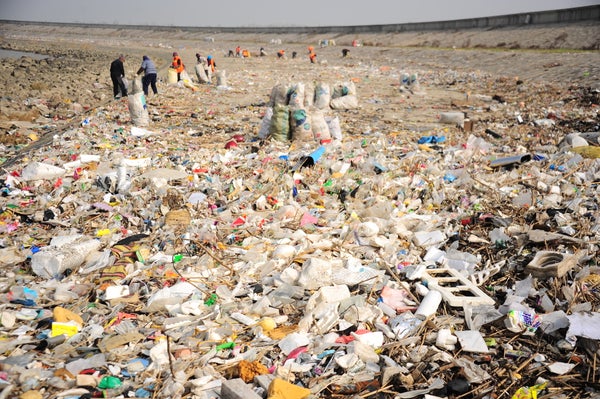
Our seas are choking on plastic. A staggering eight million metric tons wind up in oceans every year, and unraveling exactly how it gets there is critical. A recent study estimates that more than a quarter of all that waste could be pouring in from just 10 rivers, eight of them in Asia.
“Rivers carry trash over long distances and connect nearly all land surfaces with the oceans,” making them a major battleground in the fight against sea pollution, explains Christian Schmidt, a hydrogeologist at the Helmholtz Center for Environmental Research in Leipzig, Germany.
Schmidt and his colleagues dug up published data on the plastic concentration in 57 rivers of various sizes around the world. These measurements included bottles and bags, as well as microscopic fibers and beads. The researchers multiplied these concentrations by the rivers' water discharge to calculate the total weight of plastic flowing into the sea. They then fed these data into a model that compared them with the estimated weight of plastic litter generated per person per day along each river.
On supporting science journalism
If you're enjoying this article, consider supporting our award-winning journalism by subscribing. By purchasing a subscription you are helping to ensure the future of impactful stories about the discoveries and ideas shaping our world today.

Credit: Amanda Montañez; Source: “Export of Plastic Debris by Rivers into the Sea,” by Christian Schmidt et al., in Environmental Science & Technology, Vol. 51, No. 21; November 7, 2017
The results, published last November in Environmental Science & Technology, show that rivers collectively dump anywhere from 0.47 million to 2.75 million metric tons of plastic into the seas every year, depending on the data used in the models. The 10 rivers that carry 93 percent of that trash are the Yangtze, Yellow, Hai, Pearl, Amur, Mekong, Indus and Ganges Delta in Asia, and the Niger and Nile in Africa. The Yangtze alone dumps up to an estimated 1.5 million metric tons of plastic waste into the Yellow Sea.
Better waste collection and management practices in the most polluted regions would help stem the tide, Schmidt says, but raising public awareness is also crucial.