
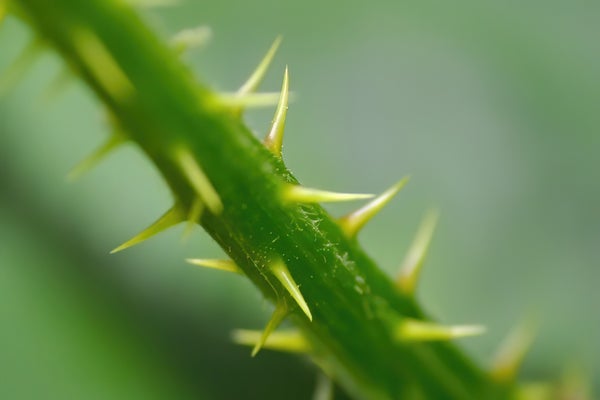
The spines of a cactus, the proboscis of a mosquito, the quills of a porcupine: straight, pointed objects serve a plethora of functions in nature. Yet no matter the size, from bacteriophages’ nanometer-scale tail fibers to narwhals’ two- or three-meter-long tusk, these structures tend to be long and slender cones whose base diameter is much smaller than their length. Now researchers have used physics to explain why this narrow shape is optimal for stingers and other piercing objects—including human-made tools such as hypodermic needles.
A stingerlike object’s dimensions are limited by two opposing constraints. To puncture its target, it must apply a force large enough to overcome the pressure created by friction. At the same time, this force must be smaller than the “critical load,” the maximum force that the structure can support without bending or breaking. A large range of geometries, from long and narrow to short and wide, satisfy both constraints. Yet living organisms do not exhibit all the possible variability. Instead nature seems to prefer narrow designs with a base-diameter-to-length ratio of around 0.06.
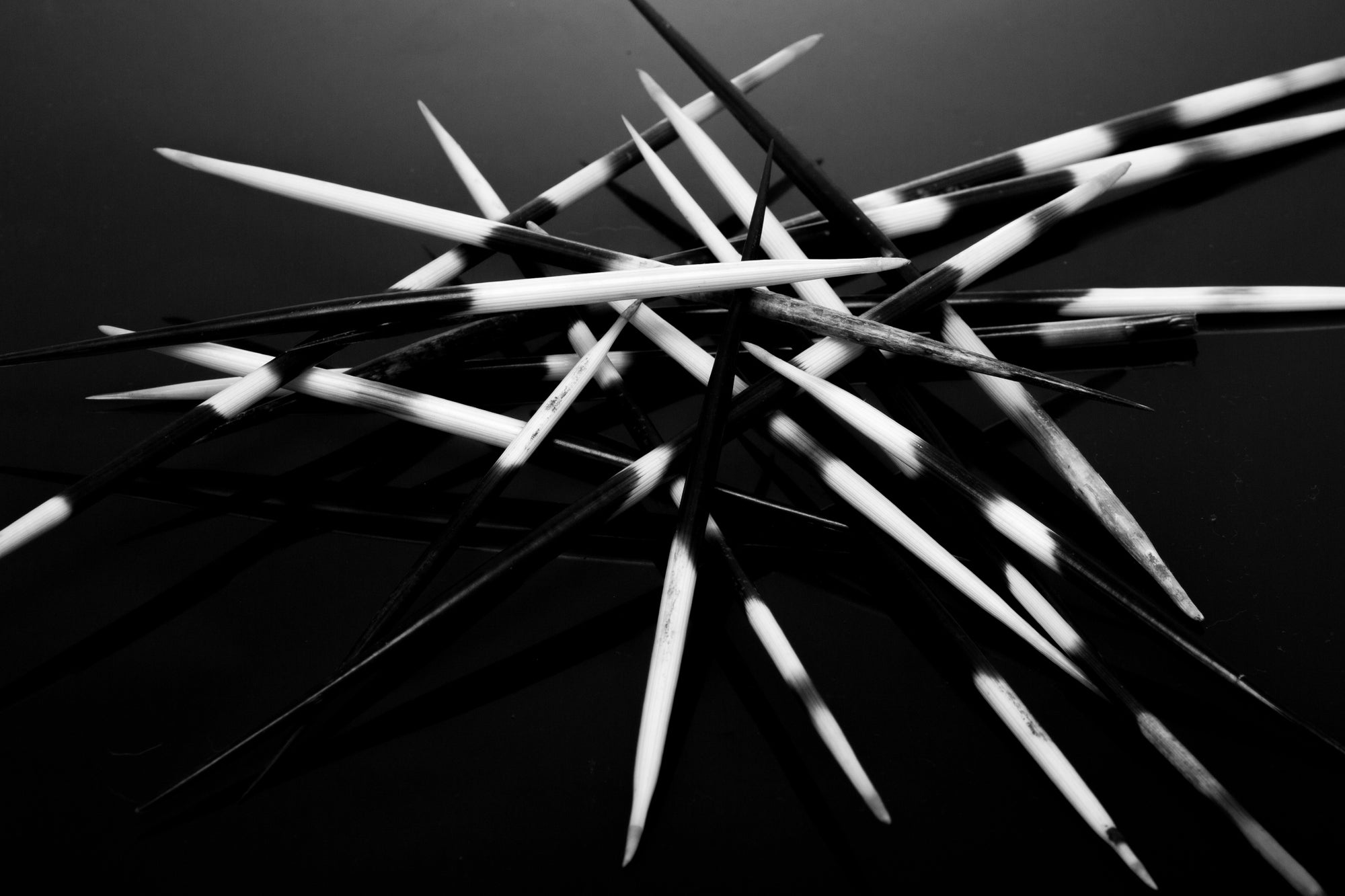
Porcupine quills. Credit: Chris Ainslie Getty Images
On supporting science journalism
If you're enjoying this article, consider supporting our award-winning journalism by subscribing. By purchasing a subscription you are helping to ensure the future of impactful stories about the discoveries and ideas shaping our world today.
That apparent predilection arises because another factor is at play: Nature tends to “live on the cheap,” says Kaare Jensen, a physicist at the Technical University of Denmark. Organisms are under evolutionary pressure to economize by using as little biological matter as possible to accomplish a given task. Wider stingers are more stable but require more material. This consideration suggests evolution would select for the narrowest designs possible: those that are barely sturdy enough to pierce their target without bending. In a paper published in June in Nature Physics, Jensen’s team showed that this design principle accurately predicts the shapes of stingers and similar structures.
Jensen and his graduate student Anneline Christensen devised a simple theoretical model for a solid conical stinger at the edge of stability. Their calculations predicted that the optimal base diameter depended on only three factors: the object’s length, the stiffness of its material and the friction from the pressure of the target tissue. The dependence on stiffness and pressure was weak: doubling the stiffness would allow the base diameter to decrease by only 21 percent, for instance. It was primarily the relationship between diameter and length that intrigued the duo.
In a major study of similar structures in the early 1980s, researchers using a different friction model proposed that the base diameter of the cone scales with its length to the power of ⅔ : thus, if the length doubled, the base diameter would need to increase by 59 percent. Jensen and Christensen’s equation, in contrast, predicted that the two should be directly proportional. In that case, doubling one would require doubling the other as well.
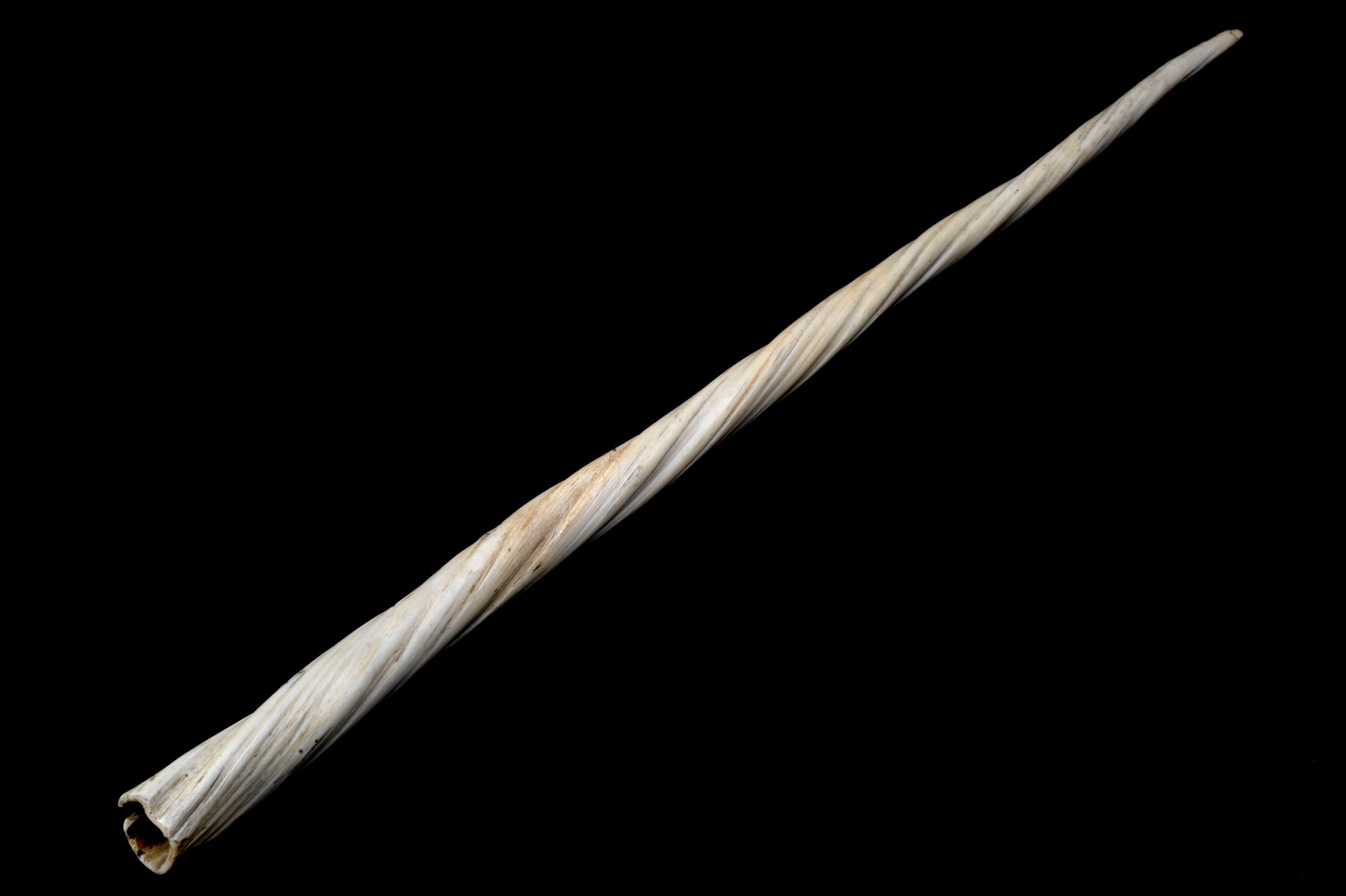
A narwhal tusk. Credit: Getty Images
To see if a linear relationship held in the natural world, Jensen’s team compiled the dimensions of nearly 140 stingers, spikes and spines in living organisms. Vertebrates and invertebrates, land and sea creatures, and plants, algae and viruses all had structures that matched the new model. Almost 100 human-made “stingers” such as needles, nails and arrows also aligned with the researchers’ predictions. “It’s always nice when you do some kind of theoretical work, and then you see it applies to something in real life,” Christensen says. “It’s not just an equation on a piece of paper."
The team did “a really nice job of tackling a pretty common design problem from a really simple mechanics perspective,” says Douglas Holmes, an engineer at Boston University, who peer-reviewed the study but was not directly involved in the research. “It was a really creative approach to the problem.” Holmes, who investigates the stability of thin structures, notes that the result has applications beyond nature. Understanding the physics of this kind of object “gives you a nice design principle for designing anything sharp,” including hypodermic needles, he says. In fact, Jensen is already using what he learned to develop more break-resistant needles for unrelated research on plant cells.
Although Jensen and Christensen’s equation describes the shape of a multitude of stingerlike structures, others have complexities not considered in the model. Some plant “stingers” are hollow or contain liquids, and some wasps intentionally bend their stinger during insertion. In both cases, the equation overestimates the base diameter. Jensen hopes to build on his research to understand the physics governing curved teeth, claws and other sharp objects in the natural world. This work could, in turn, inspire a new wave of engineering innovations, he says: “There’s quite substantial potential for learning from nature on how to design these things.”
