
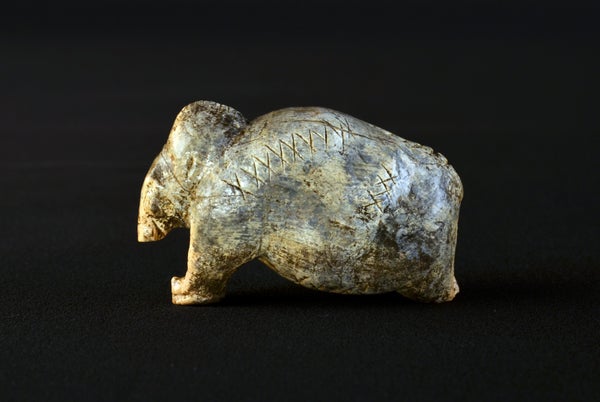
One of the oldest known pieces of art on the planet is a figurine of a mammoth that was carved in ivory by a Stone Age artisan some 40,000 years ago. The figurine was found in what is now Germany and is marked with mysterious crosses and dots. A new analysis of the object and hundreds of others found in caves in the same region now suggests the markings might have held particular meaning to their ancient creators.
Researchers examined more than 3,000 markings on 260 Stone Age objects, including the mammoth, a mysterious lion-human hybrid, and lesser known tools and musical instruments, says Ewa Dutkiewicz, a research associate at the Museum of Prehistory and Early History in Berlin. They determined that the markings’ patterns are as statistically complex as protocuneiform, an early form of writing seen on tablets from ancient Mesopotamia dating to around 3500 B.C.E.
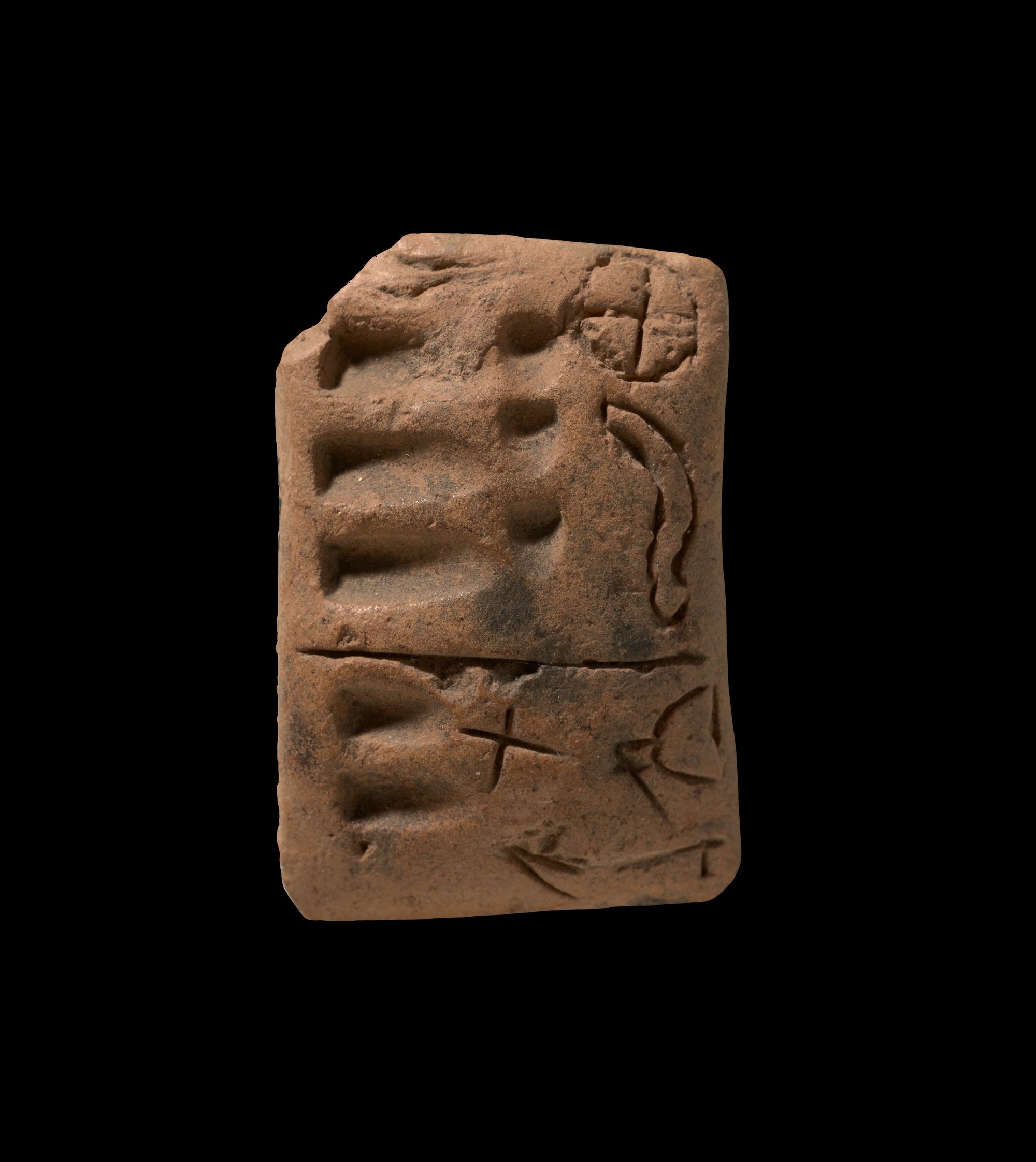
A protocuneiform tablet.
Staatliche Museen zu Berlin, Vorderasiatisches Museum/Olaf M. Tesmer
On supporting science journalism
If you're enjoying this article, consider supporting our award-winning journalism by subscribing. By purchasing a subscription you are helping to ensure the future of impactful stories about the discoveries and ideas shaping our world today.
This type of work can be “challenging,” in part because such ancient markings are practically impossible to interpret, explains Genevieve von Petzinger, a paleoanthropologist and National Geographic Emerging Explorer, who studies the origin of writing and wasn’t involved in the study. But looking for patterns in the symbols such as intentionality and repetition “are two excellent approaches for at least trying to confirm that these marks were meaningful beyond being decorative doodles.”
To find out whether the markings were decorations, tallies of hunting kills, or something else, Dutkiewicz worked with linguist Christian Bentz, who studies the history of language at Saarland University in Germany. The pair digitized the markings and compared features—such as sign diversity and repetition—with those of other, more recent sign systems. The pattern doesn’t resemble modern-day writing. But when Bentz compared the marks with early protocuneiform, he says, the similarity was unmistakable.

A 38,000-year-old figurine.
Landesmuseum Württemberg/Hendrik Zwietasch
“I couldn’t believe it. I went through the data again and again,” Bentz says. The Stone Age markings and protocuneiform appear to have equal complexity, even though their makers were separated by some tens of thousands of years and considerable distance.
Across the 260 objects, ivory figurines such as the mammoth carried more information-dense markings than tools did, the researchers say. Crosslike marks didn’t appear on objects depicting humans, and dots didn’t appear on tools—indicating that the markings must have had some kind of symbolic meaning to the Stone Age humans who made them, Bentz says. “The organization [of the markings] points to the transmission of more complex ideas,” von Petzinger says. The findings were published recently in the Proceedings of the National Academy of Sciences USA.
Decoding what these specific markings meant is an exceptionally difficult, if not impossible, task. But Bentz and Dutkiewicz’s methods could help other researchers determine what similar markings on other ancient objects from elsewhere around the world may signify—even though they cannot read them.
“The more we can learn about the selection of ‘writing’ surfaces and choices about specific images and signs, the more we will be able to learn about this period from which [writing] later emerged,” von Petzinger says.