
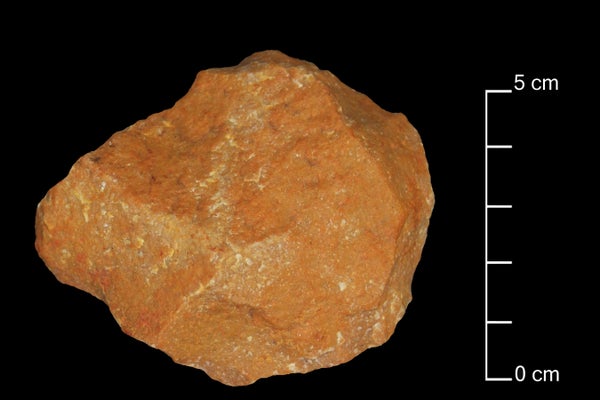
Sometime around 400,000 years ago human ancestors went on an innovation bender. No longer content to make do with only the large hand axesand other hefty cutting tools that they and their predecessors had manufactured for more than a million years, they began fashioning sophisticated new kinds of stone tools. The novel tool types made more efficient use of raw material and were smaller, more portable, among other desirable traits. The shift was, by most accounts, a major technological advance, one that may have helped its makers push into previously impenetrable lands.
For decades experts have debated which human species invented this new tool-making tradition—during what is called the Middle Stone Age in Africa and the Middle Paleolithic in Eurasia—and how it came to replace the preceding Acheulean tradition at locales across the globe. One theory holds that our own species, Homo sapiens, masterminded this technological revolution in its birthplace, Africa. From there, our forebears carried this new culture into the rest of the Old World when they began dispersing out of Africa, introducing it to the archaic species they encountered in Eurasia, including the Neandertals. A second theory posits the last common ancestor of Neandertals and H. sapiens came up with the technology and passed the know-how down to its descendant species. Or maybe, some scholars have argued, different human groups independently developed this novel way of making stone tools.
New findings from India add an intriguing data point to the picture. In a paper published in the February 1 Nature, Kumar Akhilesh and Shanti Pappu of the Sharma Center for Heritage Education, India, and their colleagues report on the recovery of stone tools from Attirampakkam, a site on India’s southeast coast, that span the time between around 385,000 and 172,000 years ago. According to the team, the artifact assemblages show signature elements of the Middle Paleolithic, including tools manufactured using the so-called Levallois strategy for obtaining thin, broad flakes from a stone core. The researchers determined the age of the tools using a technique known as luminescence dating. If they are correct in their assessment, the Attirampakkam tools are by far the oldest Middle Paleolithic tools in India, besting the previous record holders by more than 200,000 years.
On supporting science journalism
If you're enjoying this article, consider supporting our award-winning journalism by subscribing. By purchasing a subscription you are helping to ensure the future of impactful stories about the discoveries and ideas shaping our world today.
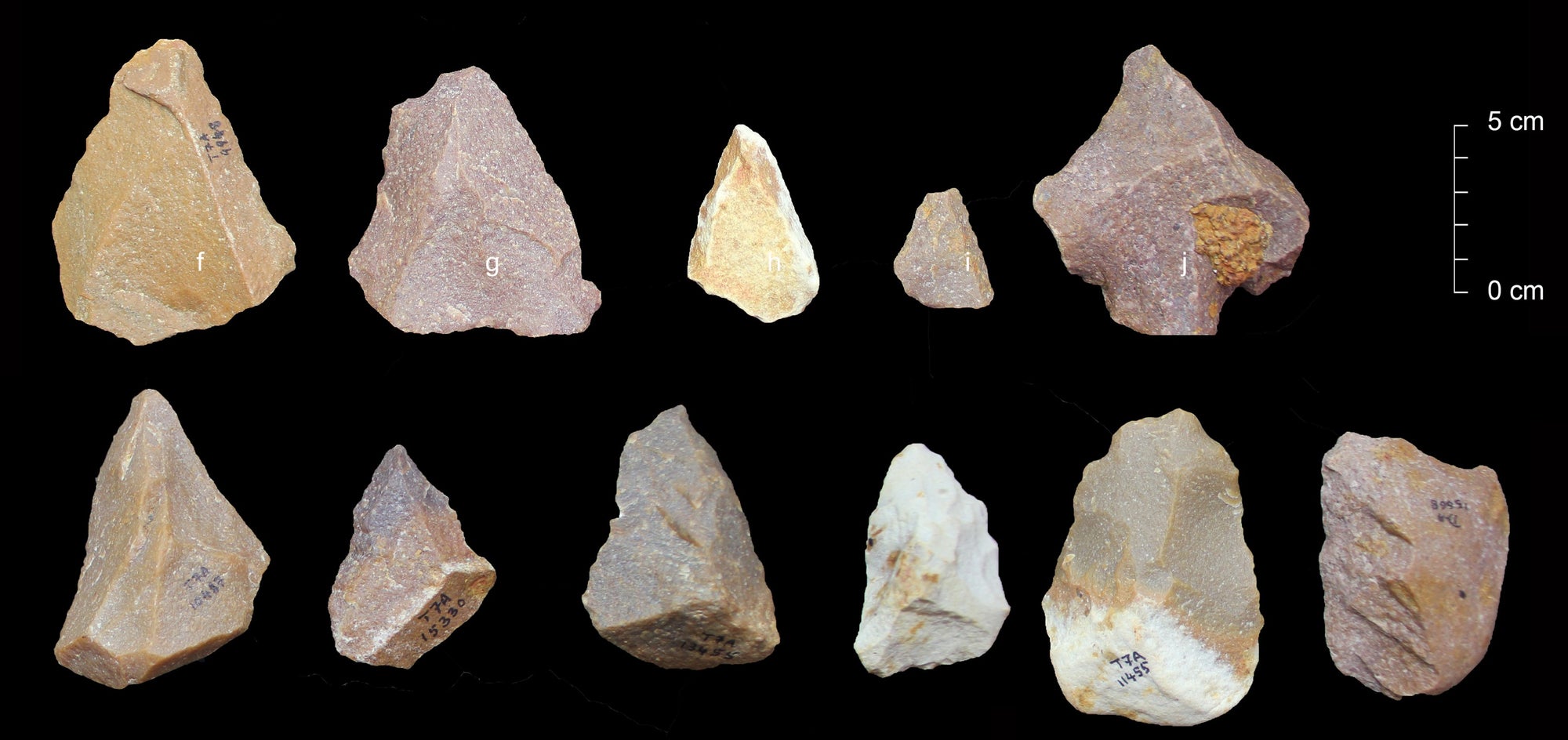
Stone tools from Attirampakkam document the presence of Middle Paleolithic technology in India as early as 385,000 years ago. Credit: Sharma Centre for Heritage Education, India
According to the discovery team, the Middle Paleolithic tools at Attirampakkam are markedly different from the older Acheulean technology at the site. Previously some researchers have argued the emergence of Middle Paleolithic technology in India was linked to dispersals of H. sapiens from Africa after around 125,000 years ago. But if people were making Middle Paleolithic stone tools as early as 385,000 years ago in India and other sites in Eurasia, and somewhat earlier in Africa, then the possibility of a far earlier dispersal of technologically advanced humans—perhaps H. sapiens—into India warrants consideration.
Recent discoveries might make such an early dispersal of our species seem more plausible than it once did. In 2017 a team working at the site of Jebel Irhoud in Morocco announced it had unearthed fossils of H. sapiens and accompanying Middle Stone Age tools dating to more than 300,000 years ago. And just last week a different team unveiled a fossil from Misliya Cave in Israel that pushes back the earliest known evidence of H. sapiens outside of Africa to around 185,000 years ago. The Misliya fossil turned up in association with Middle Paleolithic artifacts, including Levallois tools.
But other archaeologists are not so sure about the Attirampakkam team’s interpretation. Michael Petraglia of the Max Planck Institute for the Science of Human History in Germany, an authority on the Paleolithic record of India, says that although he is satisfied with the dating of the new finds, he disagrees with their classification as Middle Paleolithic. “At best, I see them as transitional between the Acheulean and the Middle Paleolithic, he says. “They could even be classified as Late Acheulean.” Petraglia notes Late Acheulean stone tool kits from India and elsewhere have many of the same tool types seen at Attirampakkam.
Rather than signaling an early dispersal of a new human group into India, Petraglia thinks the Attirampakkam remains reflect reflects regional continuity between the Acheulean and the Middle Paleolithic. “These stone tool kits were likely made by archaic humans that were already present in India,” he suggests. Human fossils from India are exceedingly rare. But Petraglia observes that an enigmatic skullcap from the Narmada River Valley, 1,000 kilometers north of Attirampakkam, shows large-brained early humans were living in India at around this time.
A similar view comes from Harvard University archaeologist Christian Tryon, an expert on the Middle Stone Age of Africa who was not involved in the new work. He says there is no reason to link the new finds to Africa. He does not see a sharp divide between the Acheulean and Middle Paleolithic artifacts at the site, which one would expect to see if a new group of humans swept into India with new technology. “It’s safest to assume it’s a local phenomenon,” he says of the cultural transition at Attirampakkam.
The hallmark of the Middle Paleolithic—the Levallois style of tool-making—“is not that complicated,” Tryon says. “It’s not outside the realm of possibility that people could arrive at it independently.” The question, then, is why they seem to have done so at roughly the same time around the world. Tryon notes climate may have played a role. If conditions became drier, for example, human groups throughout the Old World may have had to range farther to to obtain food and water, in which case it would make sense to shift to a portable technology like Levallois.
“In my view, it was only later in time that Homo sapiens made their entry into India, using Middle Paleolithic tool kits,” Petraglia says. If so, they may have met up with archaic human species there that possessed very similar technology. What happened to these early populations? “It’s a mystery,” Petraglia says, but many of them must have gone extinct. Genetic evidence links contemporary Indians to later waves of humans that spread across the subcontinent only after 60,000 years ago.