
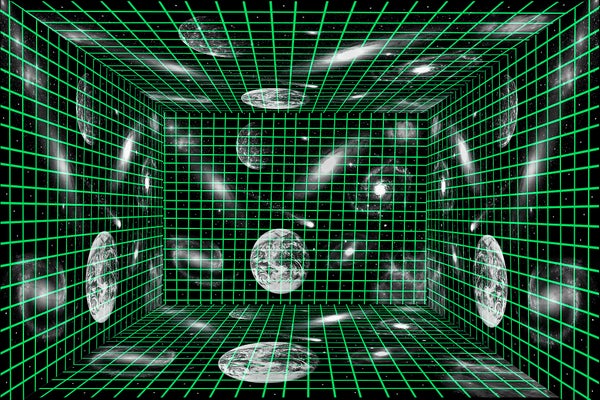
The notion that we live as characters in someone else’s video game is irresistible to many, even outside of science fiction bookshelves. Googling the term “simulation hypothesis” returns numerous results that debate whether the universe is a computer simulation—a concept that some scientists actually take seriously. Since a pivotal 2016 debate at the American Museum of Natural History, the idea has bounced from the scientific realm to the sphere of pop culture.
Unfortunately, this is not a scientific question; there is no objective way to test it. We will probably never know if it’s true and by focusing too much on this hypothesis, we are wasting time. We can, instead, use this idea to advance scientific knowledge.
The 18th-century philosopher Immanuel Kant argued that the universe ultimately consists of things-in-themselves that are unknowable. While he held the notion that objective reality exists, he said our mind plays a necessary role in structuring and shaping our perceptions. Kant was ahead of his time but undeniably insightful. Modern neuroscience and cognitive science have revealed that our perceptual experience of the world is the result of many stages of processing by sensory systems and cognitive functions in the brain. No one knows exactly what happens within this black box. What we do know is these brain processes generate a vast amount of additional information beyond what our senses perceive. Take vision, for instance; our retinas are two flat surfaces that only receive two-dimensional information, but our cognitive functions add the third dimension to our perceptual experience.
On supporting science journalism
If you're enjoying this article, consider supporting our award-winning journalism by subscribing. By purchasing a subscription you are helping to ensure the future of impactful stories about the discoveries and ideas shaping our world today.
If empirical experience fails to reveal reality, reasoning won’t reveal reality either since it relies on concepts and words that are contingent on our social, cultural and psychological histories. Again, a black box.
So, if we accept that the universe is unknowable, we also accept we will never know if we live in a computer simulation. And then, we can shift our inquiry from “Is the universe a computer simulation?” to “Can we model the universe as a computer simulation?” These are two very different questions. The former confines us in speculation; the latter puts us on track to doing science.
Modeling reality is what we do as scientists. To facilitate our comprehension of the world, we build models based on conceptual metaphors that are familiar to us. In Newton’s era, we imagined the universe as a clock. In Einstein’s, we uncovered the standard model of particle physics.
Now that we are in the information age, we have new concepts available to us, such as the computer, information processing, virtual reality and simulation. Unsurprisingly, these new concepts inspire us to build new models of the universe. To build one based on the computer simulation metaphor, we need to address some key questions such as “Where is the computer?” and “What is it made of?”
In a universe modeled as computation, the computer that renders space and its contents should be outside of space. To make progress in building such a model, one option is to place the computer inside a black hole. However, once something gets into a black hole, it is effectively cut off from our observation. A computer there could not get out and affect our universe.
Another option is to put the computer in a parallel universe, the existence of which some scientists have theorized. But each parallel universe is supposed to be independent; whatever happens (including running a computer) in another one cannot impact ours.
It seems that the most obvious “place” it could be is the Platonic realm of Forms. According to Plato, the reality we see is just a shadow of this realm, where abstract entities such as numbers, perfect geometric shapes and other abstract concepts exist.
Numbers, for instance, are not in space—no one has kicked the number two or bumped into the number three—and yet we do things with numbers all the time; we count with them, we measure with them, we formulate scientific theories with them. We wouldn’t have mathematics without numbers, and we wouldn’t have physics without mathematics. Many prominent professional mathematicians hold the notion that numbers have an objective existence in the realm of Forms.
By locating numbers in the realm of Forms, the bedrock of physics is given an objective reality independent of the human mind. Likewise, by locating a computer in the realm of Forms, we have a philosophical foundation for constructing the computer simulation metaphor-based model of reality.
Models are not the reality, however. There is no point in arguing if the universe is a clock, a set of particles or an output of computation. All these models are tools to be deployed to deal with the unknown and to make discoveries. And the more tools we have, the more effective and insightful we can become.
It can be envisaged that comparable to the process of building previous scientific models, developing the “computer simulation” metaphor–based model will also be a hugely rewarding exercise. The new model will provide a new lens through which new discoveries will be made about the cosmos. We will greatly widen our horizons and broaden the scope of scientific inquiry. That’s much more satisfying than spending the day wondering if you are trapped in a version of The Sims.
This is an opinion and analysis article, and the views expressed by the author or authors are not necessarily those of Scientific American.